

Plagiarism Meaning: Academic Types & Misconceptions

Plagiarism is one of the most frequently discussed issues in academic writing, publishing, and professional communication, yet its meaning is often far more nuanced than it first appears.
You need to look beyond a simple definition, since questions about paraphrasing, common knowledge, citation practices, and textual similarity continue to create confusion across many forms of writing.
This guide takes a clearer look at what plagiarism means, how it appears in practice, what should not be mistaken for plagiarism, and how responsible attribution can help writers avoid unnecessary risks.
What Does Plagiarism Mean?
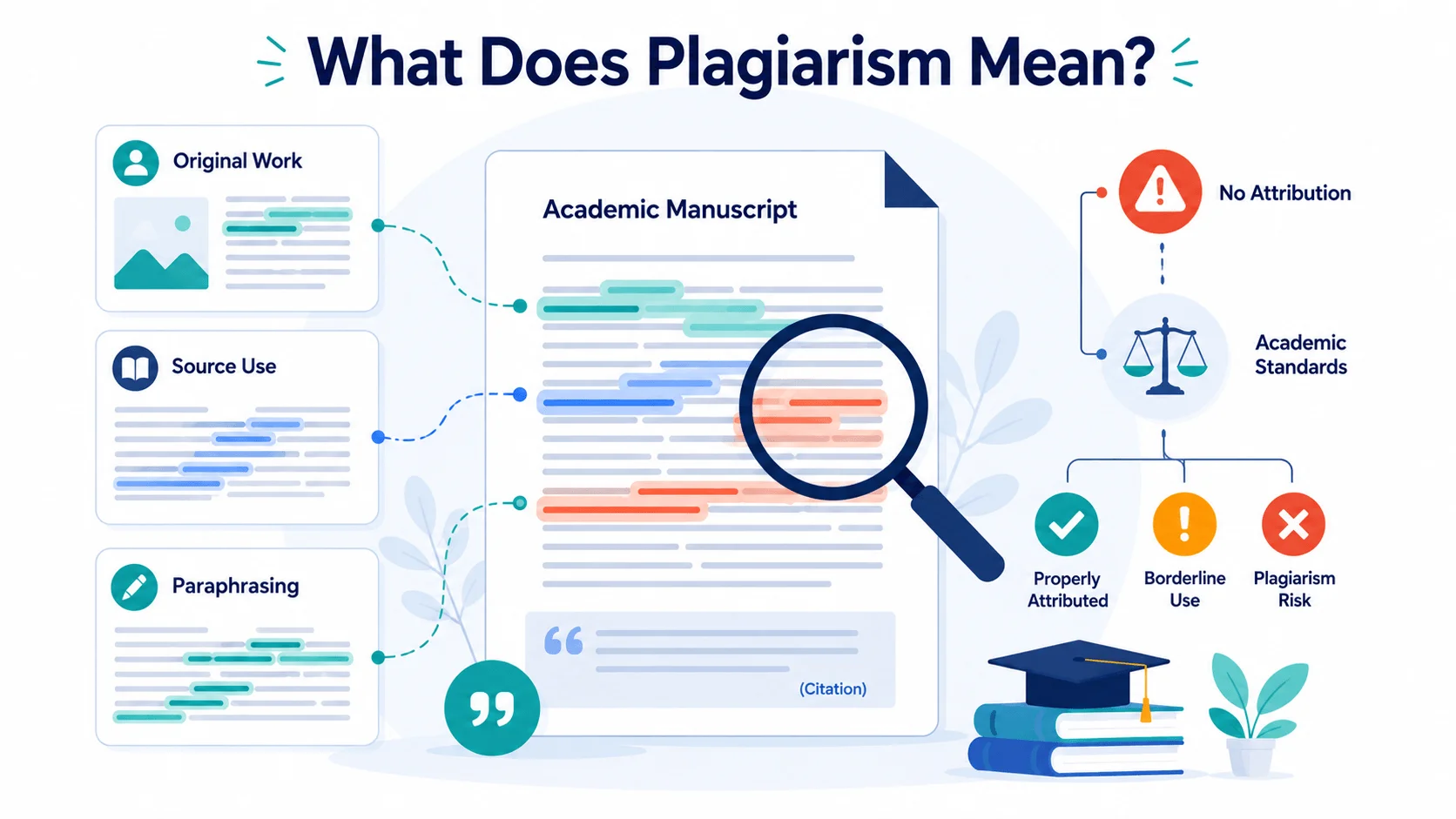
Plagiarism refers to using another person’s words, ideas, expressions, or original work without proper acknowledgment while presenting them as one’s own. Although the term is most commonly associated with writing, plagiarism can also involve research findings, visual materials, data, creative content, or other intellectual contributions across academic and professional fields.
In everyday usage, plagiarism is often understood as direct copying. However, academic and publishing standards typically apply a broader and more nuanced interpretation of the concept.
Plagiarism in Academic and Research Contexts
In academic writing and scholarly publishing, plagiarism is evaluated not only through textual similarity, but also through attribution, originality, and transparency of source use. A passage does not need to be copied word for word to raise concerns. Closely paraphrased sections, borrowed sentence structures, reused ideas, or heavily source-dependent writing may still fall within the scope of plagiarism when the original contribution is not clearly distinguished from existing material.
Because of this, academic definitions of plagiarism are often stricter than general public understanding. Even when citations are included, excessive reliance on the original wording or organizational structure may still be viewed as problematic under institutional or editorial standards.
Common Elements of Plagiarism
Although definitions vary slightly across institutions and publishers, plagiarism generally involves one or more of the following:
Using another person’s language without proper attribution
Reproducing ideas or arguments without acknowledgment
Closely paraphrasing source material while retaining its original structure or expression
Presenting externally derived content as original work
The central concern is typically not similarity alone, but whether the source has been represented clearly, accurately, and responsibly.
Major Types of Plagiarism in Academic and Research Writing
As discussed earlier, plagiarism in academic and publishing contexts is defined far more precisely than many people realize. The following are some of the most representative and commonly recognized types of plagiarism in academic and research writing.
1. Direct Plagiarism
Direct plagiarism refers to copying another source word-for-word without quotation marks or proper citation. This is the clearest and most serious form of plagiarism.
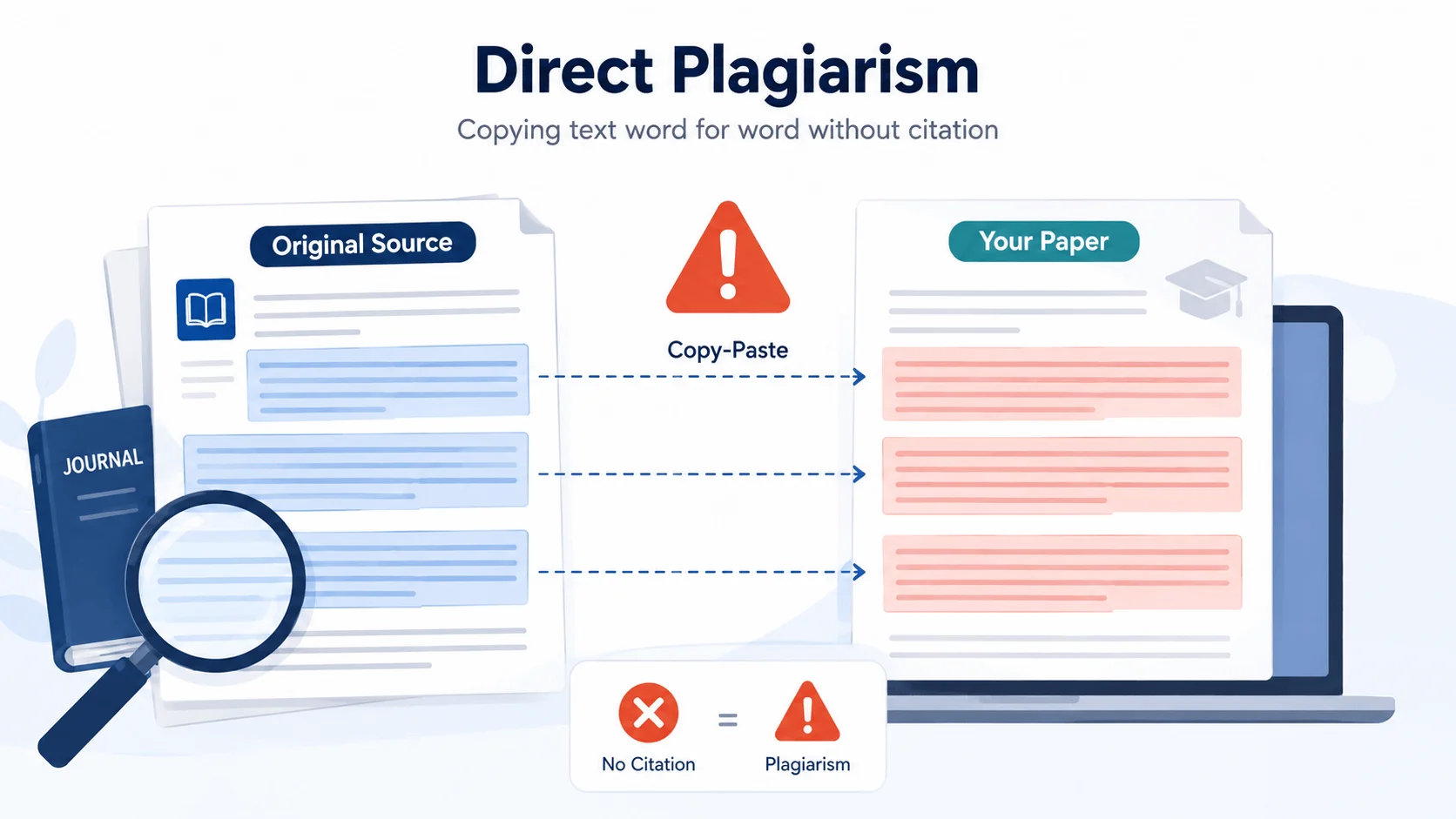
Common examples include:
Copying paragraphs from published papers
Using online content without attribution
Submitting someone else’s work as your own
Because the wording remains identical, this type is usually easy to detect with plagiarism checkers.
2. Paraphrasing Plagiarism
Paraphrasing plagiarism happens when a writer slightly rewrites someone else’s content while keeping the original sentence structure, logic, or wording too close to the source.
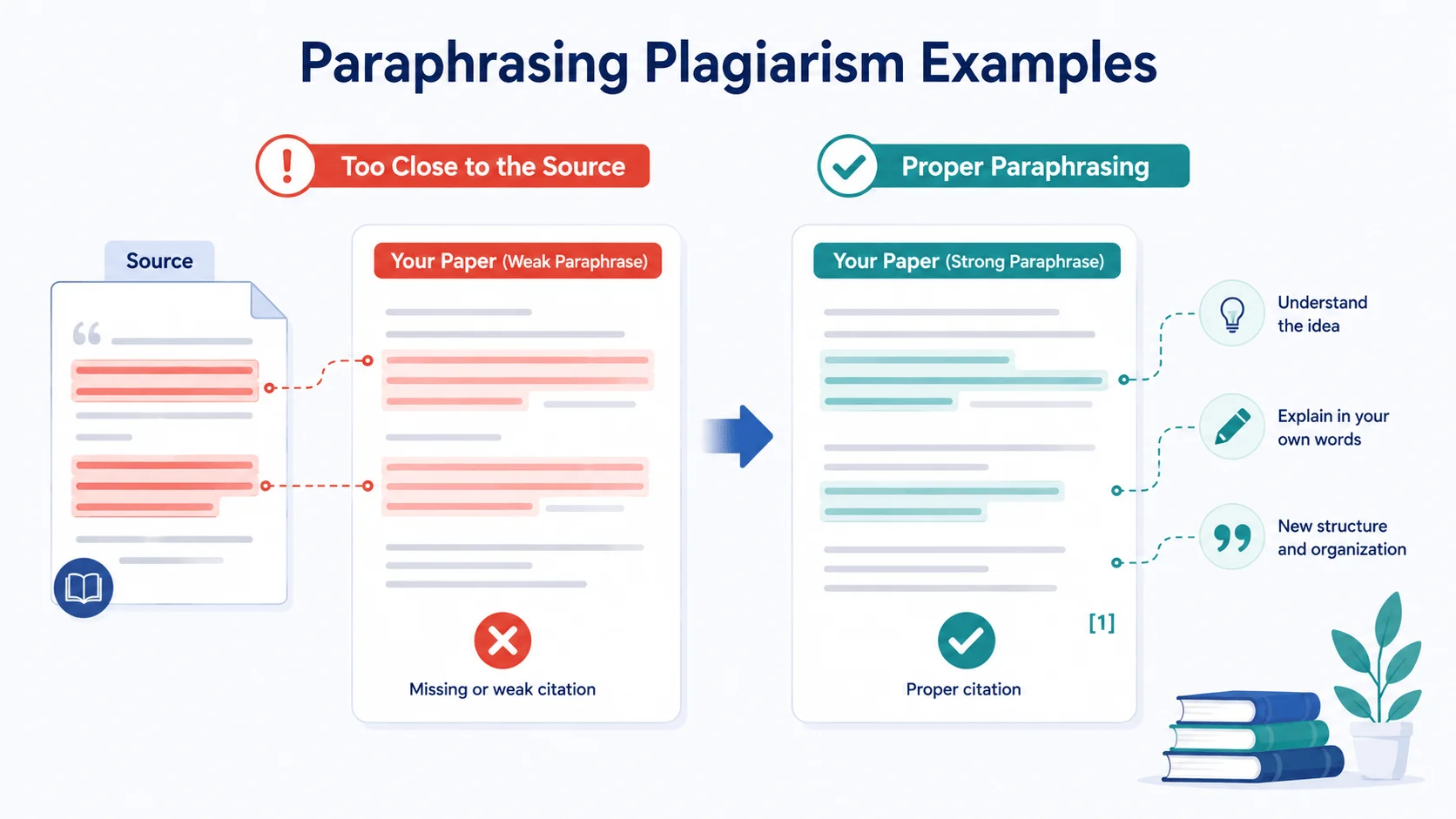
This often occurs when authors:
Replace words with synonyms only
Rearrange sentence order minimally
Rewrite source material without citation
Proper paraphrasing still requires both substantial rewriting and source acknowledgment.
3. Mosaic or Patchwork Plagiarism
Mosaic plagiarism involves combining phrases, sentence structures, or ideas from multiple sources into one piece of writing without proper credit.
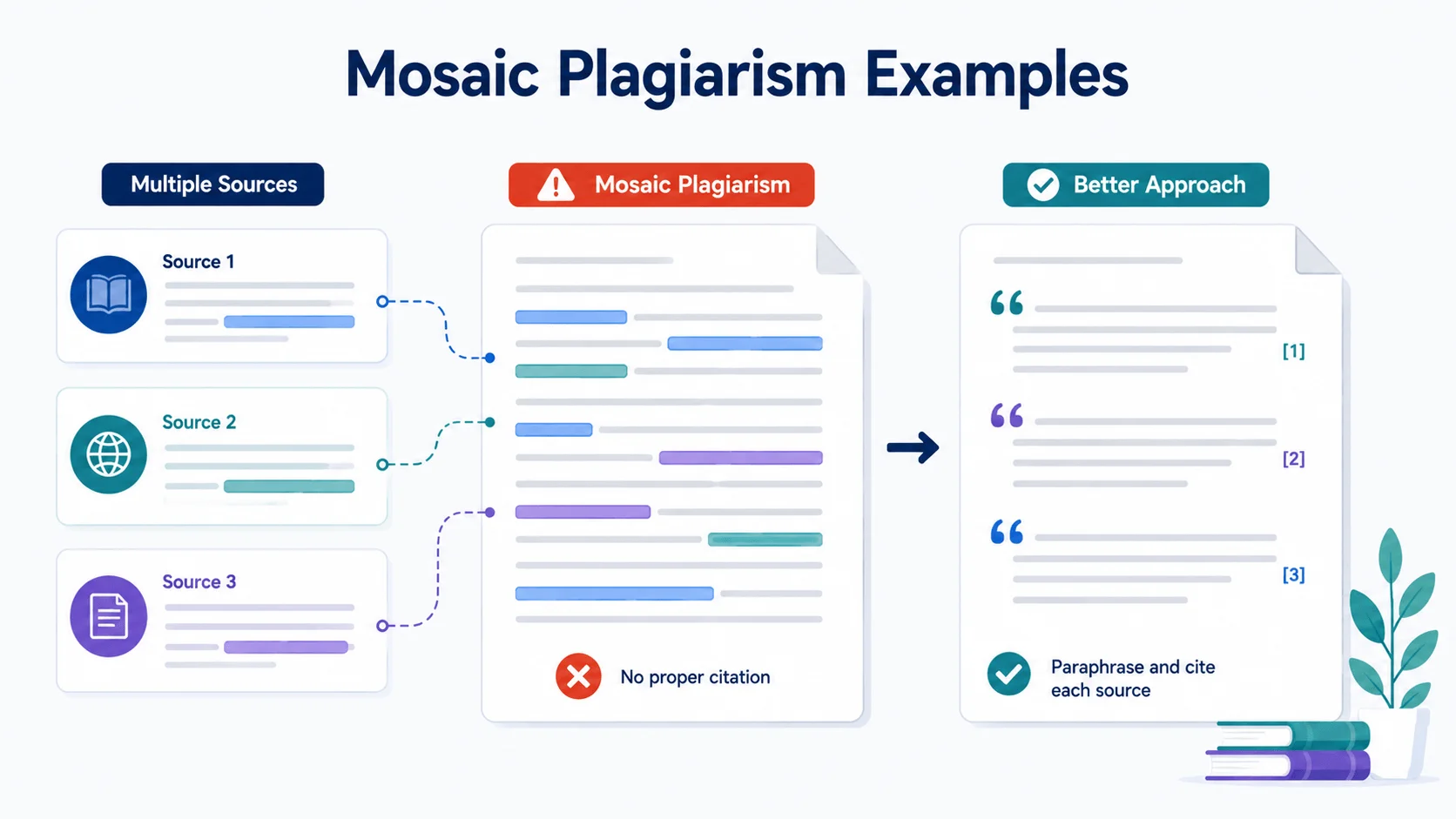
Common situations include:
Stitching together literature review content
Mixing copied phrases from several papers
Using source text as a writing template
This form is especially common in academic drafting because the copied material may appear partially original at first glance.
4. Self-Plagiarism
Self-plagiarism occurs when authors reuse their own previously published work without disclosure or citation.
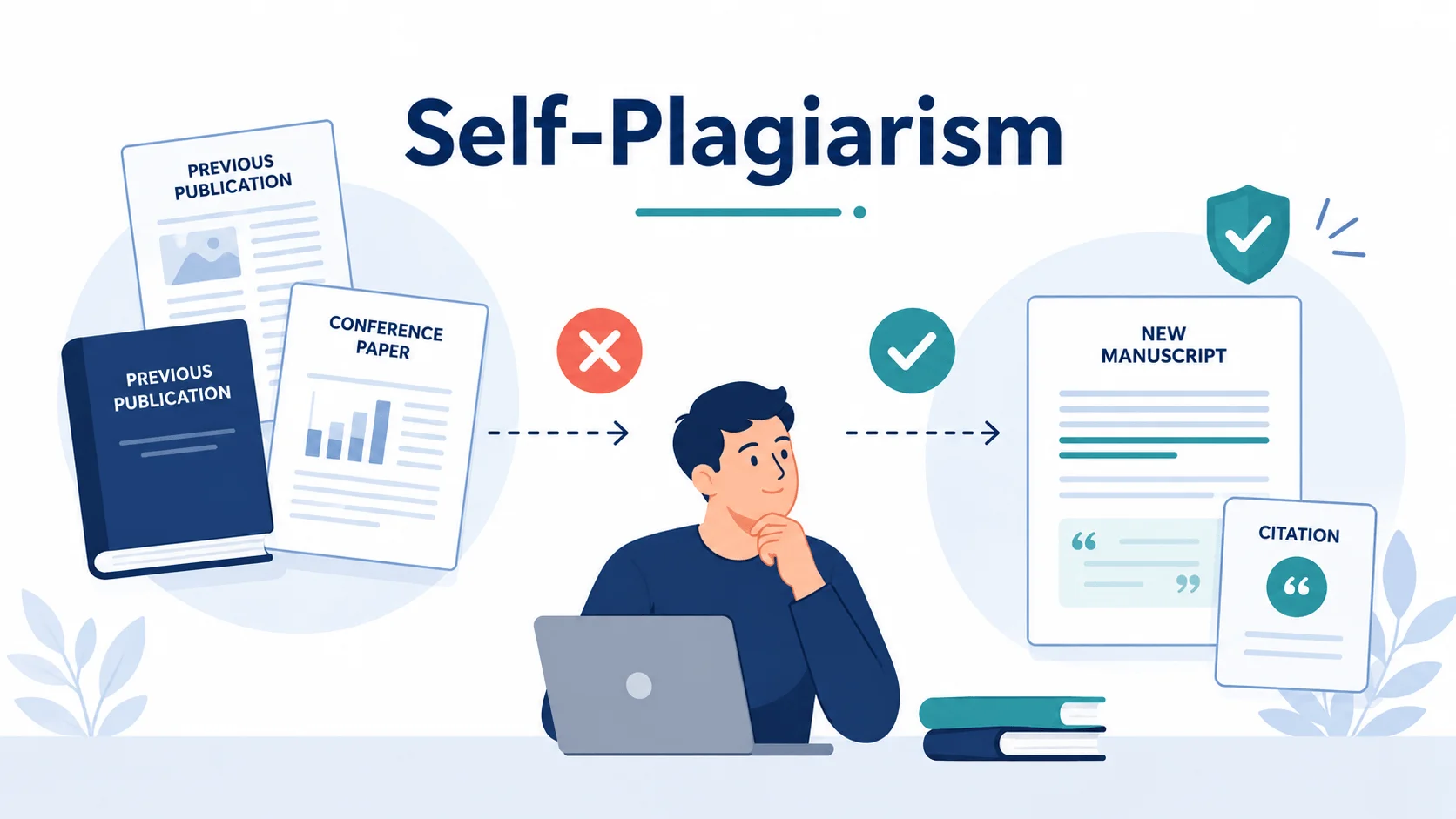
Examples include:
Reusing methodology sections across papers
Republishing old research results
Submitting similar manuscripts to multiple journals
Although the work belongs to the same author, journals still expect transparency regarding prior publication.
5. Idea Plagiarism
Idea plagiarism refers to using another researcher’s original concepts, hypotheses, interpretations, or arguments without acknowledgment.
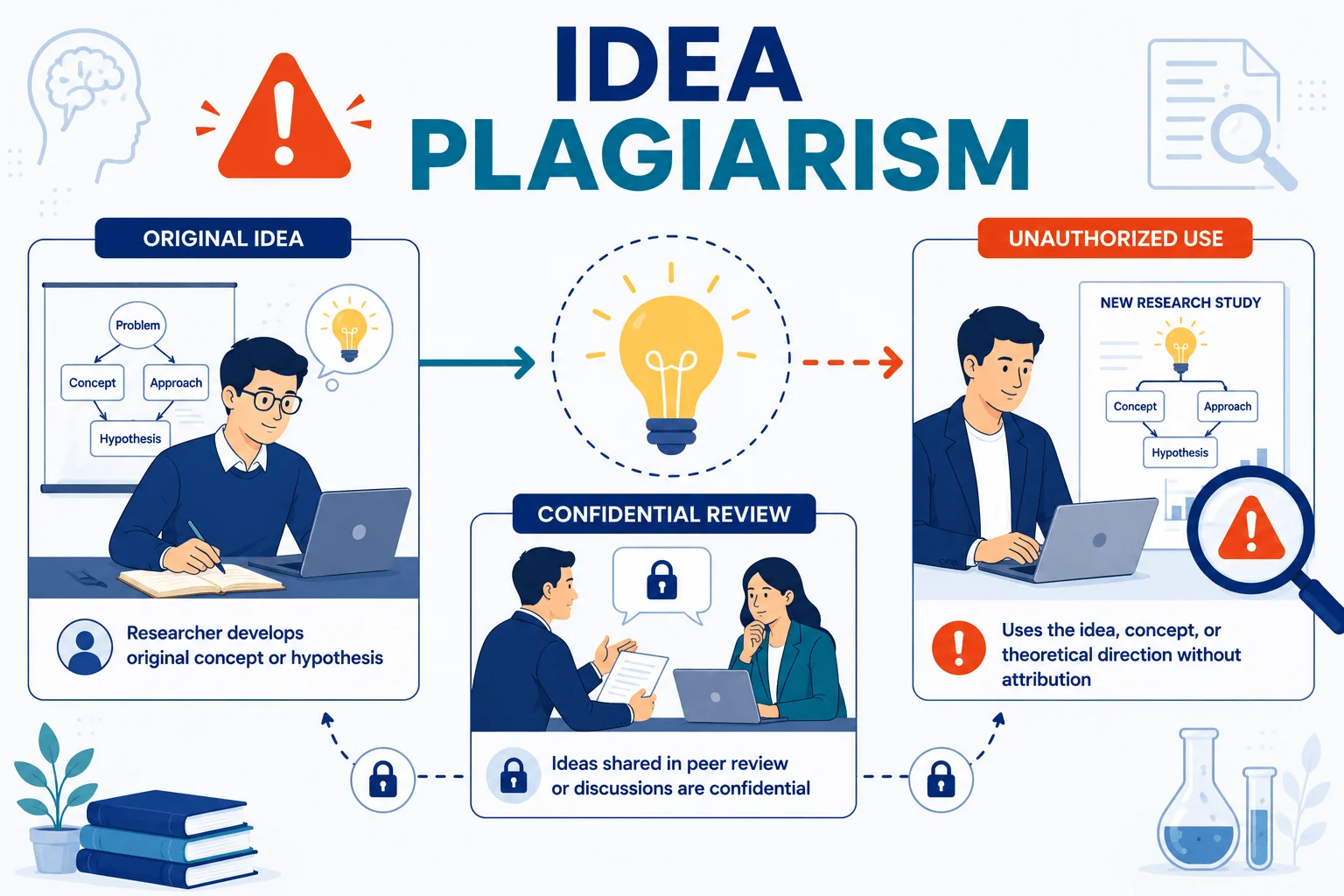
This can happen when someone:
Takes ideas from unpublished discussions
Uses peer review content improperly
Presents another scholar’s theory as independent thinking
Even without copied wording, failing to credit intellectual contributions may still constitute plagiarism.
6. Data Plagiarism
Data plagiarism involves using another researcher’s experimental results, datasets, graphs, or findings without permission or attribution.
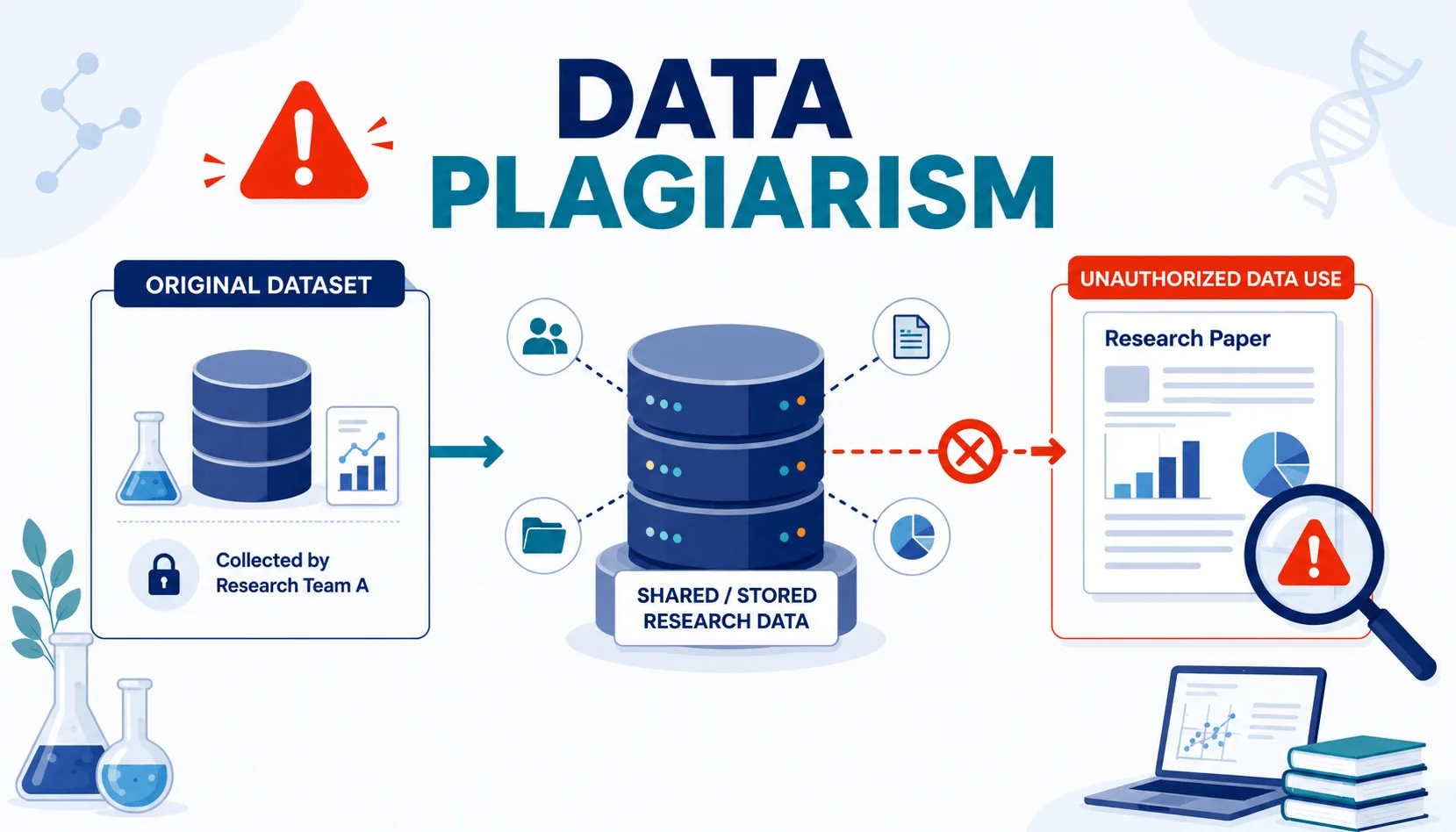
Common examples include:
Reusing tables or figures without citation
Presenting shared lab data as independent research
Copying statistical results from another study
In scientific publishing, this type is considered particularly serious because it affects research credibility and ownership.
7. Source-Based Plagiarism
Source-based plagiarism occurs when citations are misleading, inaccurate, or fabricated.
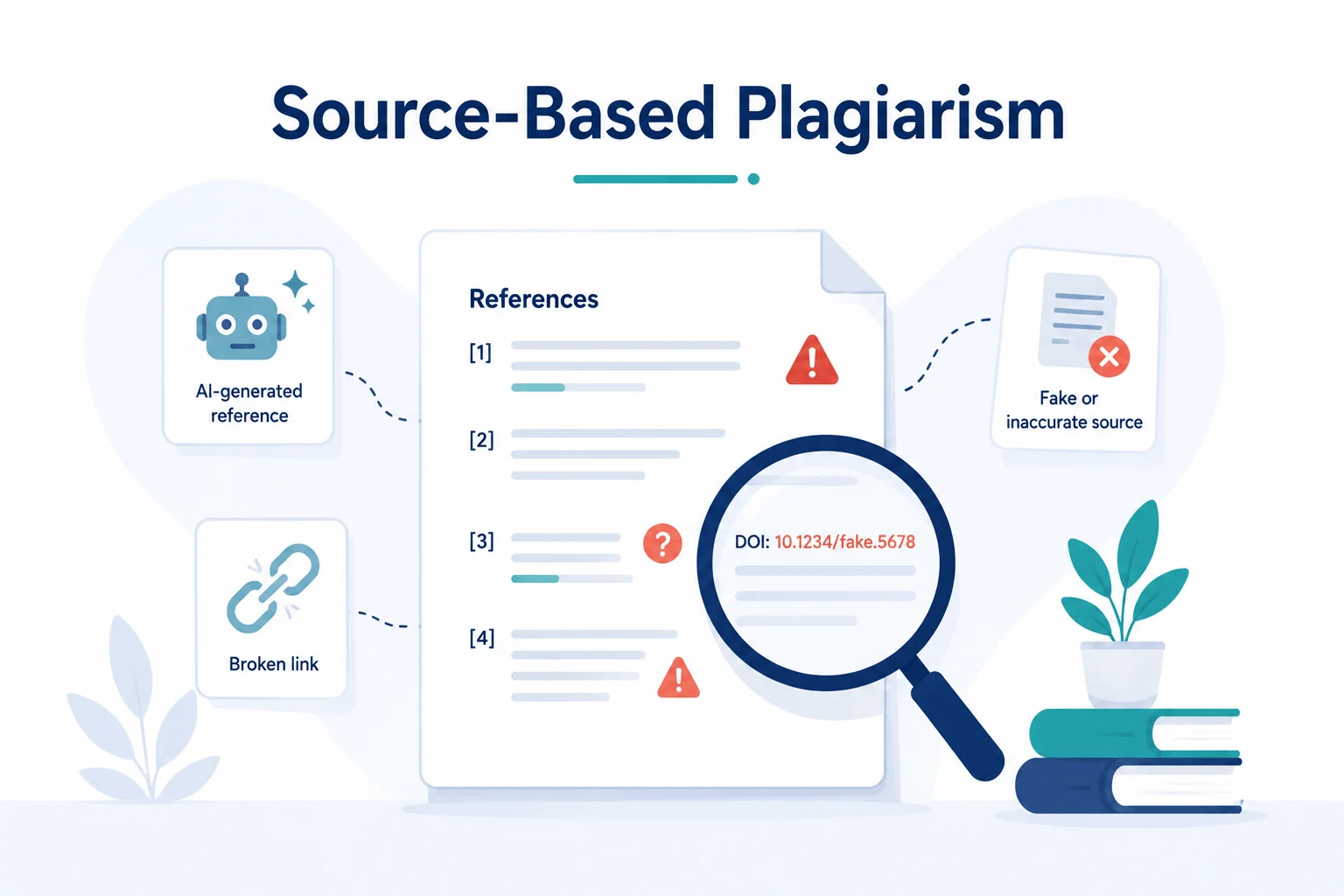
This may include:
Citing sources that were never consulted
Misrepresenting secondary citations as original reading
Inventing references to strengthen arguments
Although less visible than text copying, it still violates academic honesty standards.
8. Accidental Plagiarism
Accidental plagiarism happens when writers unintentionally fail to cite sources correctly or misunderstand citation rules.
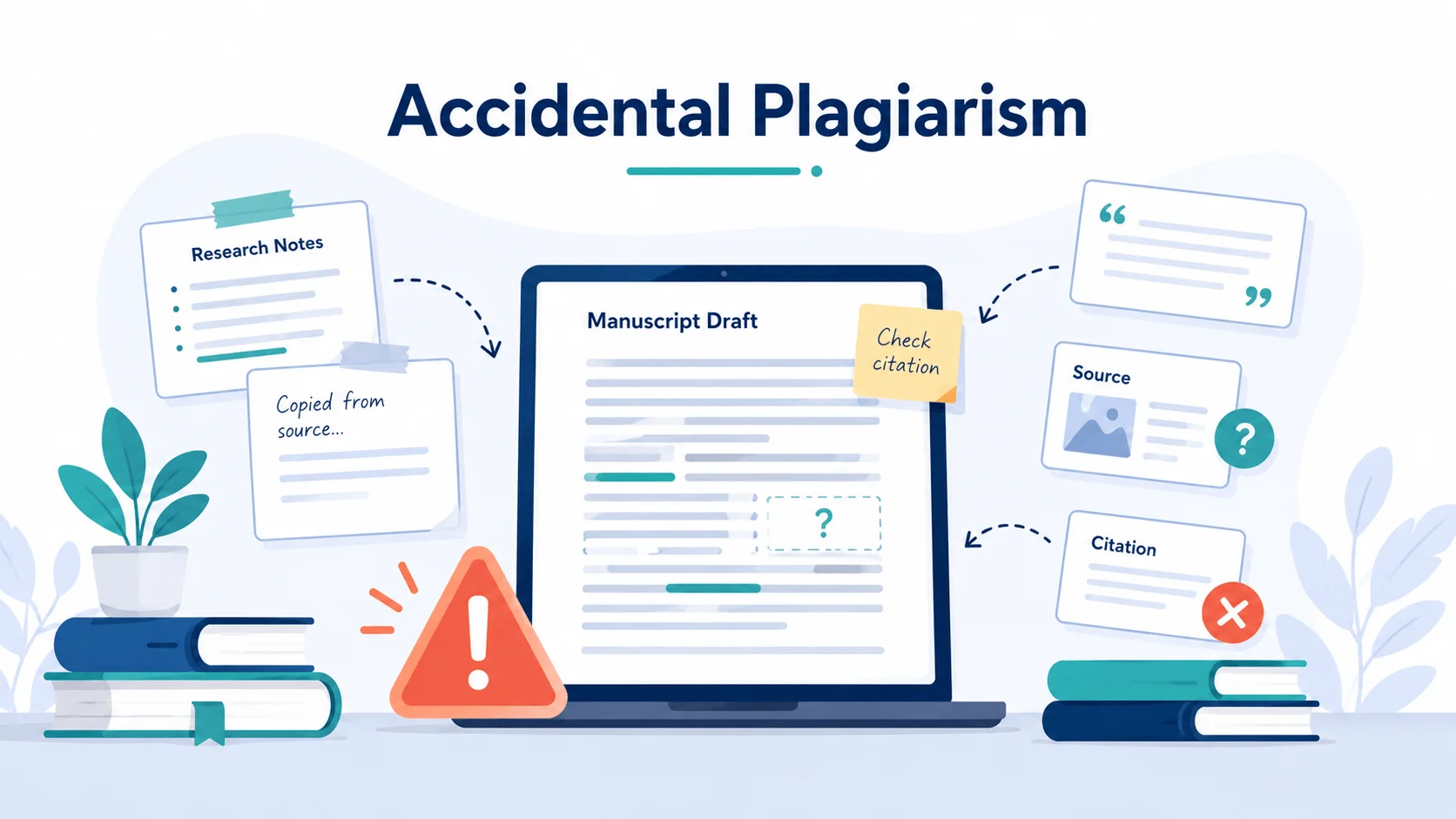
Typical causes include:
Poor note-taking during research
Missing quotation marks
Incomplete references
Inexperience with academic citation styles
Even when unintentional, accidental plagiarism can still lead to journal or institutional concerns, which is why careful citation review is essential before submission.
9. AI-Related Plagiarism
AI-related plagiarism involves presenting AI-generated or AI-assisted content as entirely original human writing without appropriate disclosure when disclosure is required by institutional or publisher policies.
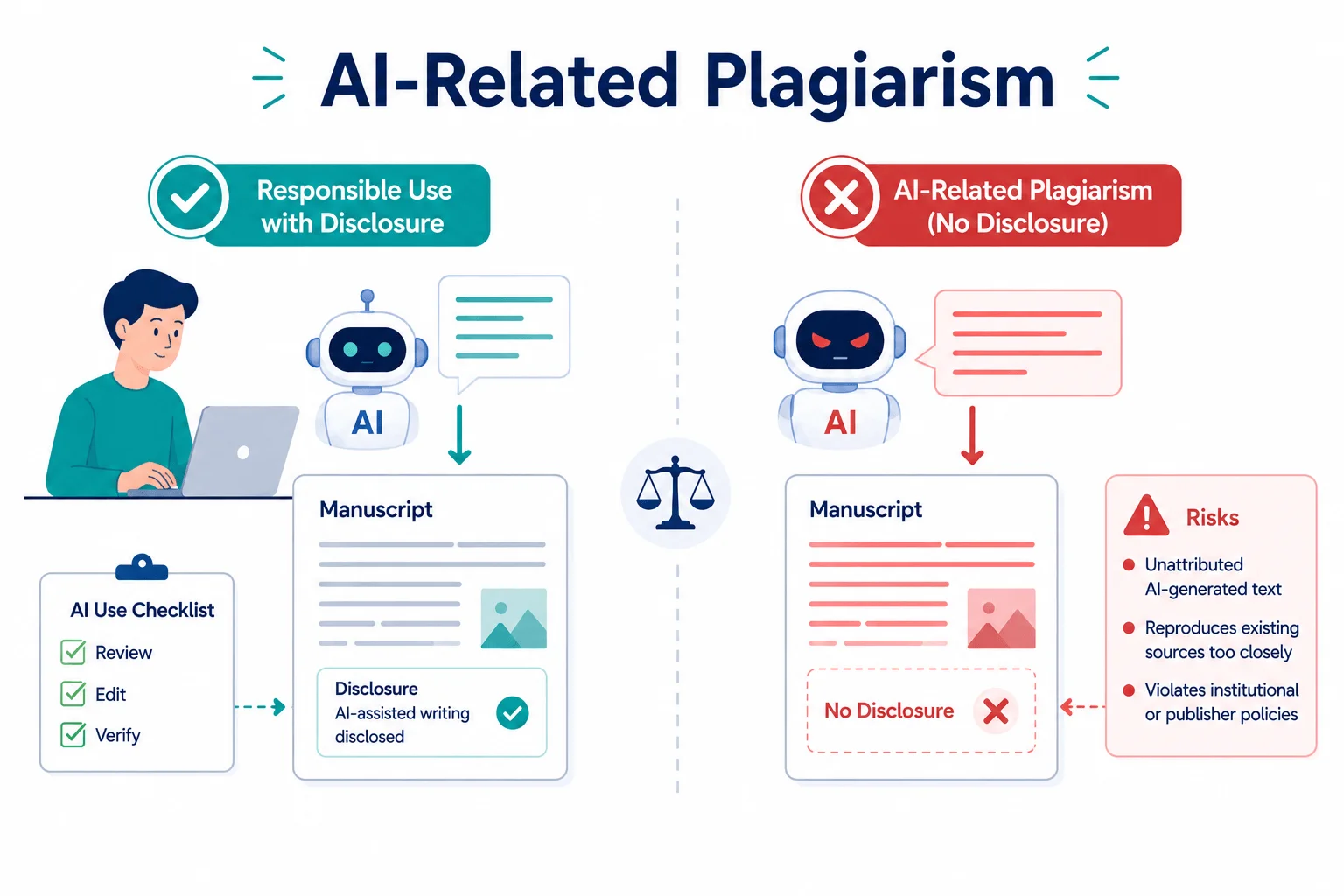
Concerns may also arise when AI-generated text reproduces existing source material too closely or introduces unattributed phrasing into a manuscript.
What Is Not Considered Plagiarism?
After reviewing the major forms of plagiarism, it is equally important to understand that not all textual similarity or source usage constitutes misconduct.
Academic writing regularly involves engaging with existing literature, incorporating prior research, and building upon established knowledge. The distinction depends largely on how source material is attributed, paraphrased, and integrated into the author’s own analysis.
The following situations are generally not considered plagiarism when handled correctly.
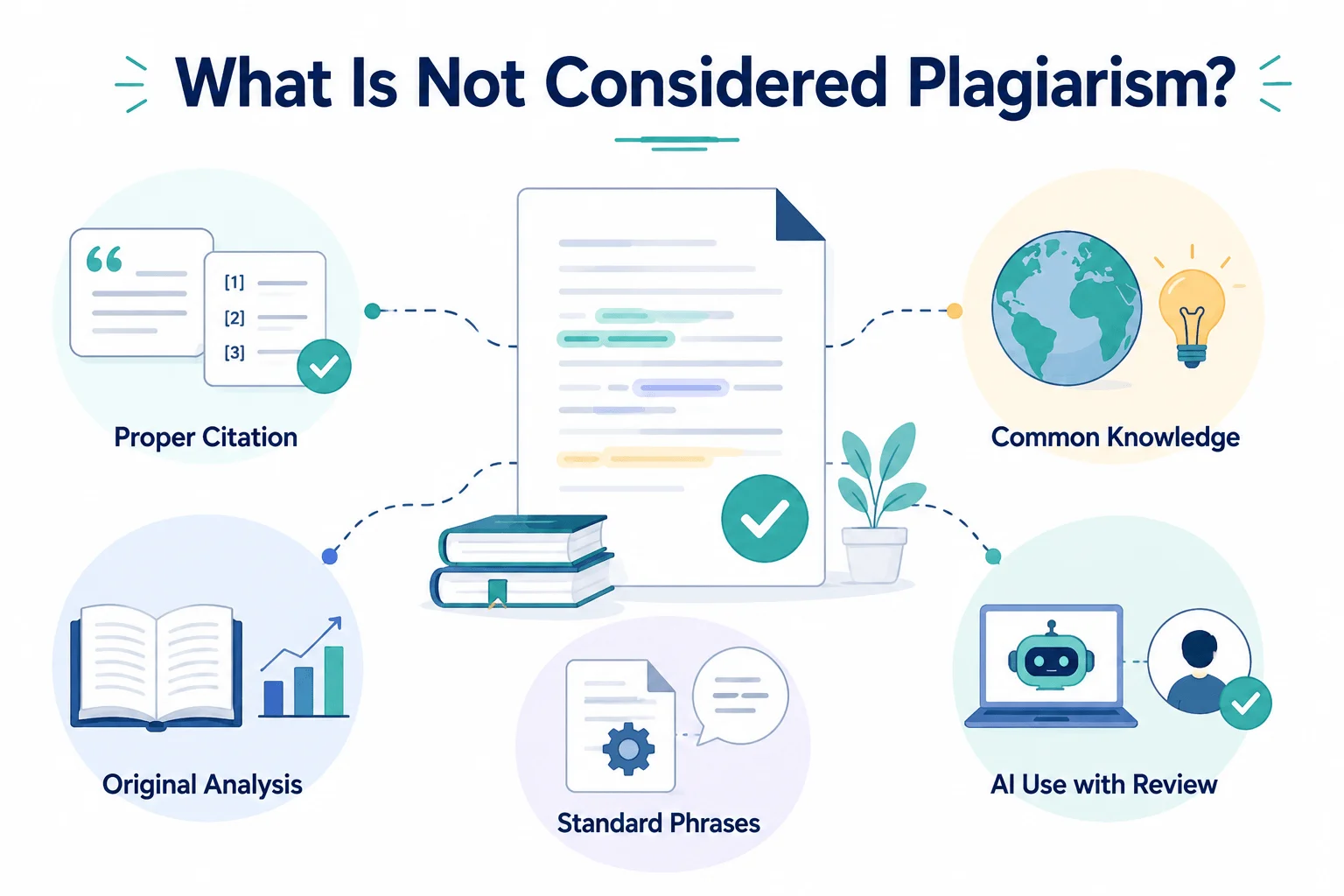
Using Proper Citations
Quoting, paraphrasing, or summarizing another author’s work with accurate citation is a normal part of academic writing. Research depends on engaging with existing scholarship, and properly credited sources do not count as plagiarism.
Discussing Common Knowledge
Widely known facts that are easily verifiable usually do not require citation. For example, basic scientific principles, historical dates, or universally accepted concepts are generally considered common knowledge.
However, specialized interpretations or discipline-specific claims may still require references.
Writing Original Analysis Based on Sources
Academic papers often build arguments using previous research. Using published studies to support your own analysis is not plagiarism as long as the ideas are interpreted independently and sources are clearly acknowledged.
Limited Reuse of Standard Technical Phrases
In some disciplines, certain technical expressions or methodological descriptions may naturally appear similar across papers. Small overlaps in standard terminology are usually not treated as plagiarism, especially in highly specialized scientific writing.
Using AI Tools With Proper Review and Disclosure
Many journals now allow limited AI-assisted writing if authors remain responsible for the accuracy, originality, and citation of the final manuscript. Problems usually arise when AI-generated text is submitted without editing, verification, or disclosure required by the journal.
How to Check Whether Your Writing Contains Plagiarism
Plagiarism detection has become an essential part of journal publication, academic evaluation, and professional research review. Before submission, many authors now evaluate their manuscripts not only for citation accuracy, but also for textual similarity, paraphrasing quality, and source attribution issues that may raise editorial concerns.
Current plagiarism detection methods generally fall into two main categories.
Manual Review
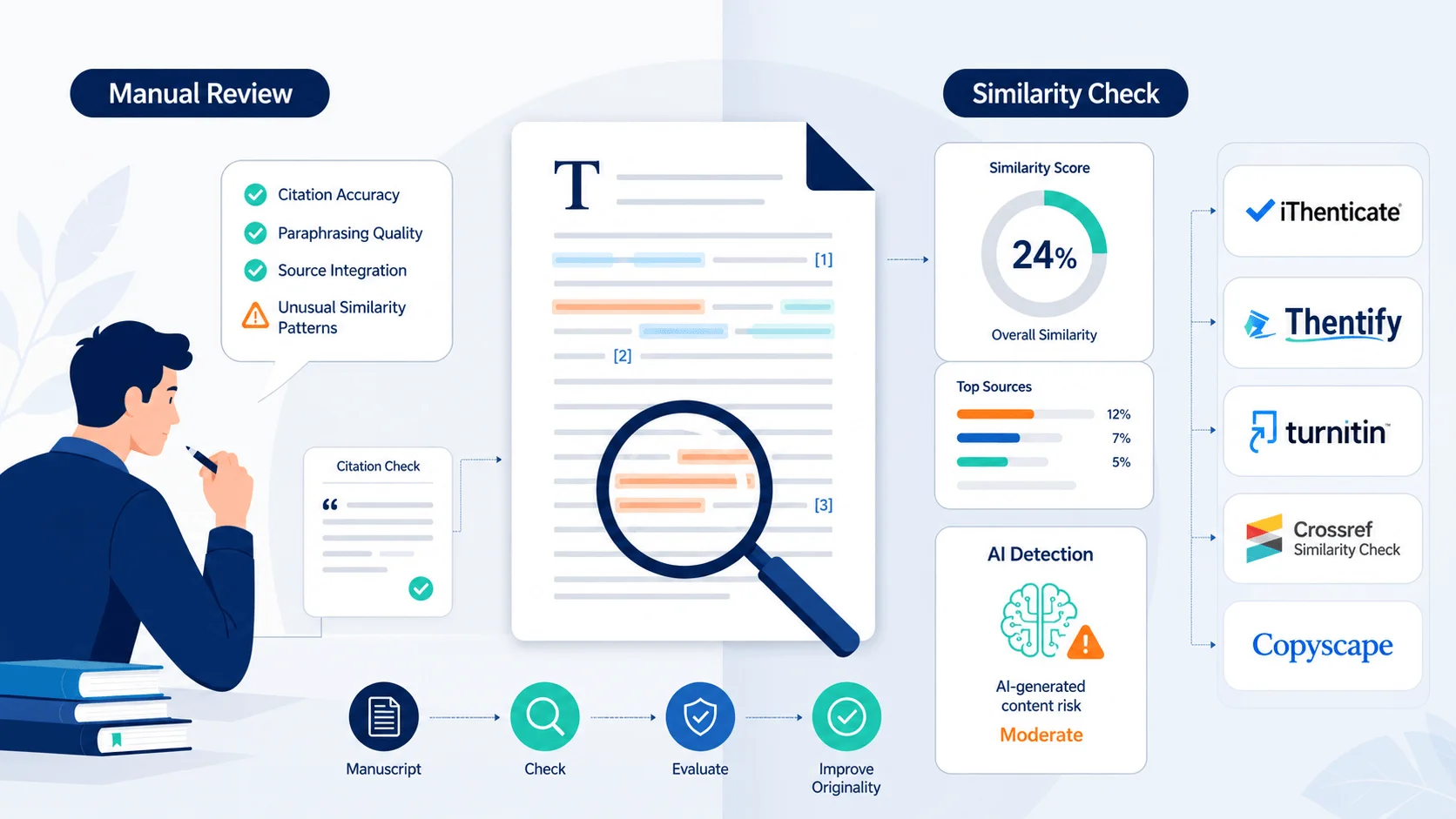
Manual plagiarism checking involves reviewing a manuscript directly for citation consistency, paraphrasing quality, source integration, and unusual similarity patterns. This process is commonly performed by authors, supervisors, peer reviewers, or journal editors during manuscript evaluation.
Although manual review may not identify every textual overlap, it remains important for assessing context, originality, and whether borrowed material has been represented appropriately within the writing.
Professional Plagiarism Detection Tools
Professional plagiarism detection tools use large academic databases and similarity-matching algorithms to identify overlapping text between a manuscript and existing sources. These systems are widely used by universities, publishers, and journals as part of the submission and review process.
Commonly recognized academic plagiarism detection tools include:
iThenticate — widely used by journals and publishers for scholarly manuscript screening
Thentify — an online similarity detection platform designed to generate reports closely aligned with iThenticate outputs, making it particularly useful for pre-submission similarity checking
Turnitin — commonly used in universities and academic institutions
Crossref Similarity Check — integrated into many publisher and journal workflows
Copyscape — often used for website and online content plagiarism detection
It is also worth noting that many institutions and publishers now incorporate AI detection systems alongside traditional plagiarism screening. These tools are designed to evaluate whether sections of a manuscript may contain AI-generated or heavily AI-assisted writing, particularly in contexts where disclosure or originality requirements apply.
Final Thoughts
Plagiarism can seem straightforward at first, but as you have seen throughout this guide, the real meaning often depends on context, attribution, and how source material is used in practice.
Hopefully, the discussion and examples here have helped make these distinctions easier to recognize in your own writing.
If nothing else, it is worth remembering that good academic writing is not about avoiding every similarity at all costs. It is about engaging with existing knowledge responsibly, clearly, and with confidence.
FAQ

What is the meaning of plagiarism?
Plagiarism means using someone else’s words, ideas, data, or original work without giving proper credit. In academic writing, plagiarism can be intentional or accidental.
Is paraphrasing considered plagiarism?
Paraphrasing can still be plagiarism if the original source is not cited properly. Changing words alone does not make an idea your own.
What is the difference between plagiarism and iThenticate similarity?
iThenticate similarity report measures overlapping text, while plagiarism involves improper use of another person’s work. A paper may have high similarity without plagiarism, or low similarity with unethical paraphrasing.
Is accidental plagiarism still a serious issue?
Yes. Even unintentional plagiarism can lead to manuscript rejection, correction requests, or damage to academic credibility.
How can researchers avoid plagiarism more effectively?
Researchers can reduce plagiarism risks by citing sources during drafting, keeping organized literature notes, paraphrasing carefully, and reviewing manuscripts before submission.
What are the consequences of plagiarism?
The consequences of plagiarism may include manuscript rejection, academic penalties, reputational damage, or article retraction, depending on the severity and context of the case.