

Is Plagiarism Illegal? Laws, Consequences & Examples

Plagiarism remains a significant concern in scholarly publishing, particularly when reviewing similarity reports from tools such as iThenticate and other AI-aware detection systems.
As artificial intelligence becomes increasingly integrated into research writing, questions surrounding authorship and liability have become more complex.
This raises an important question: Can plagiarism lead to legal consequences?
While plagiarism is commonly treated as a matter of academic misconduct, certain cases may also involve copyright infringement or broader intellectual property disputes, making the issue more nuanced than it initially appears.
Is Plagiarism Illegal? (Short Answer First)
Plagiarism is not always illegal.
But it can become illegal in certain situations.
In most academic and research contexts, plagiarism is treated primarily as an ethical or professional misconduct issue rather than a criminal offense. Institutions, publishers, and research organizations establish their own integrity standards, with violations typically addressed through internal investigations, editorial sanctions, funding restrictions, or reputational consequences rather than formal legal proceedings.
However, the issue may enter legal territory when plagiarism involves copyrighted material, unauthorized reproduction of protected intellectual property, commercial advantage, or fraudulent misrepresentation. In such circumstances, concerns surrounding academic misconduct can overlap with copyright infringement or broader legal disputes.
Understanding this distinction requires a clear separation between ethical violations and legal liability.
Plagiarism vs Copyright Infringement (Key Difference)
To understand whether plagiarism is illegal, you need to clearly distinguish it from copyright infringement. These two concepts are often confused, but they operate in completely different domains.
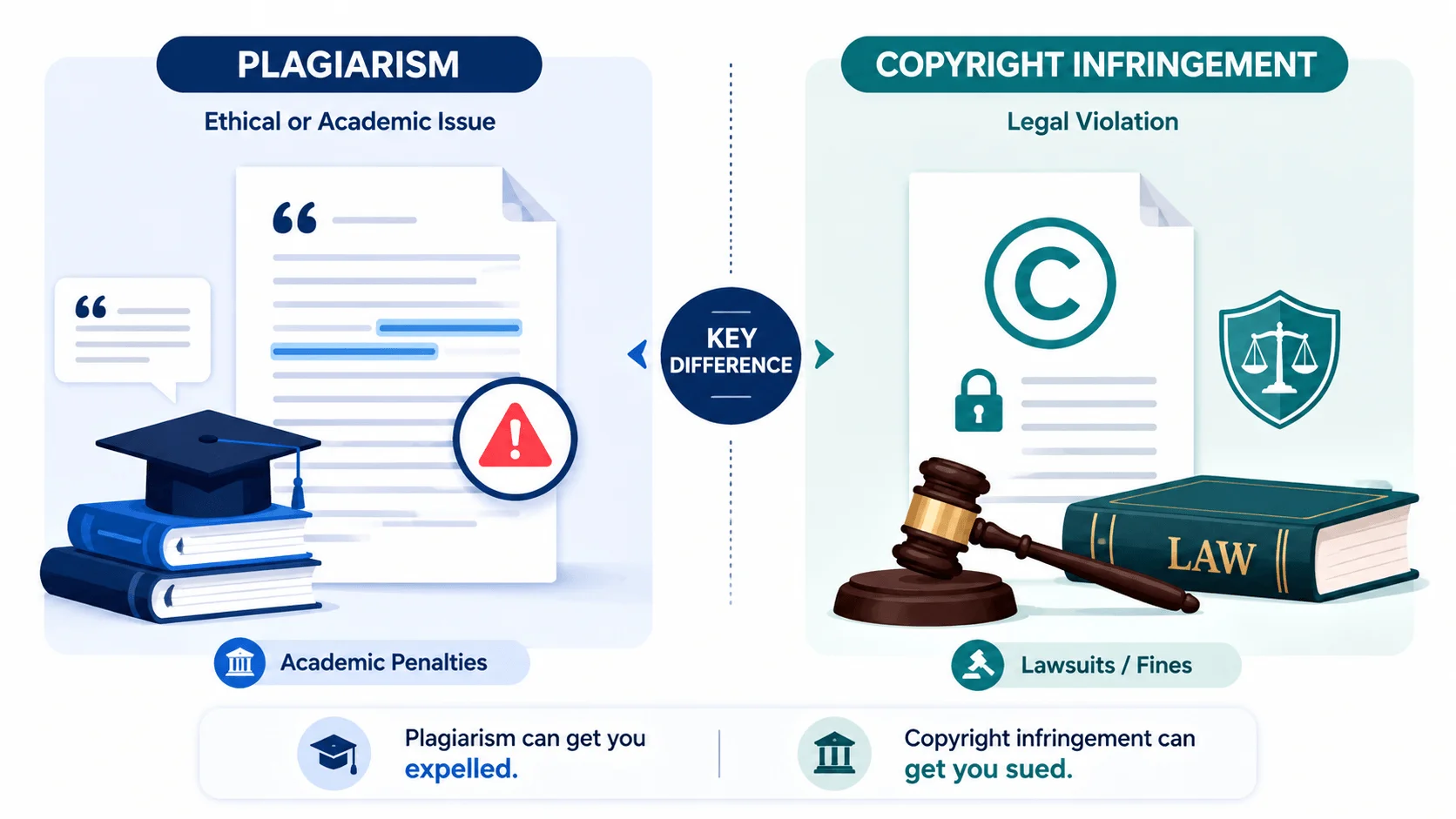
Plagiarism is primarily an ethical or academic violation. It happens when you present someone else’s ideas, words, or work as your own without proper credit. Schools, universities, and academic institutions define and enforce plagiarism rules, which is why the consequences usually stay within the educational system.
Copyright infringement, on the other hand, is a legal violation. It occurs when you use, reproduce, or distribute someone else’s protected work without permission, especially under laws such as U.S. copyright law. This is where legal consequences come into play.
Here’s a clearer comparison:
Aspect | Plagiarism | Copyright Infringement |
|---|---|---|
Nature | Ethical issue | Legal violation |
Where it applies | Schools, academia | Law (e.g., U.S. copyright law) |
Consequences | Academic penalties | Lawsuits, fines |
This distinction is critical because not all plagiarism breaks the law—but some forms of content misuse do.
Plagiarism can get you expelled. Copyright infringement can get you sued.
When Is Plagiarism Actually Illegal?
While plagiarism is usually an academic issue, there are specific situations where it crosses into legal territory. This typically happens when the act involves protected content, financial benefit, or intentional deception.
Common situations where plagiarism becomes illegal include:
Publishing copyrighted content without permission
If you copy and publish someone else’s protected work—such as articles, books, or media—you may violate copyright law.
Using someone’s work for commercial gain
Profiting from content that isn’t yours, especially without authorization, can lead to legal claims and financial liability.
Ghostwriting combined with fraud
Submitting work written by someone else as your own in high-stakes contexts (academic, business, or professional) may be considered misrepresentation or fraud.
Professional plagiarism (journalism, business, media)
In industries where originality is legally and contractually required, plagiarism can result in lawsuits, contract breaches, or reputational damage.
These examples show that plagiarism becomes illegal not just because of copying—but because of how the content is used.
What Happens If You Get Caught?
Academic Consequences
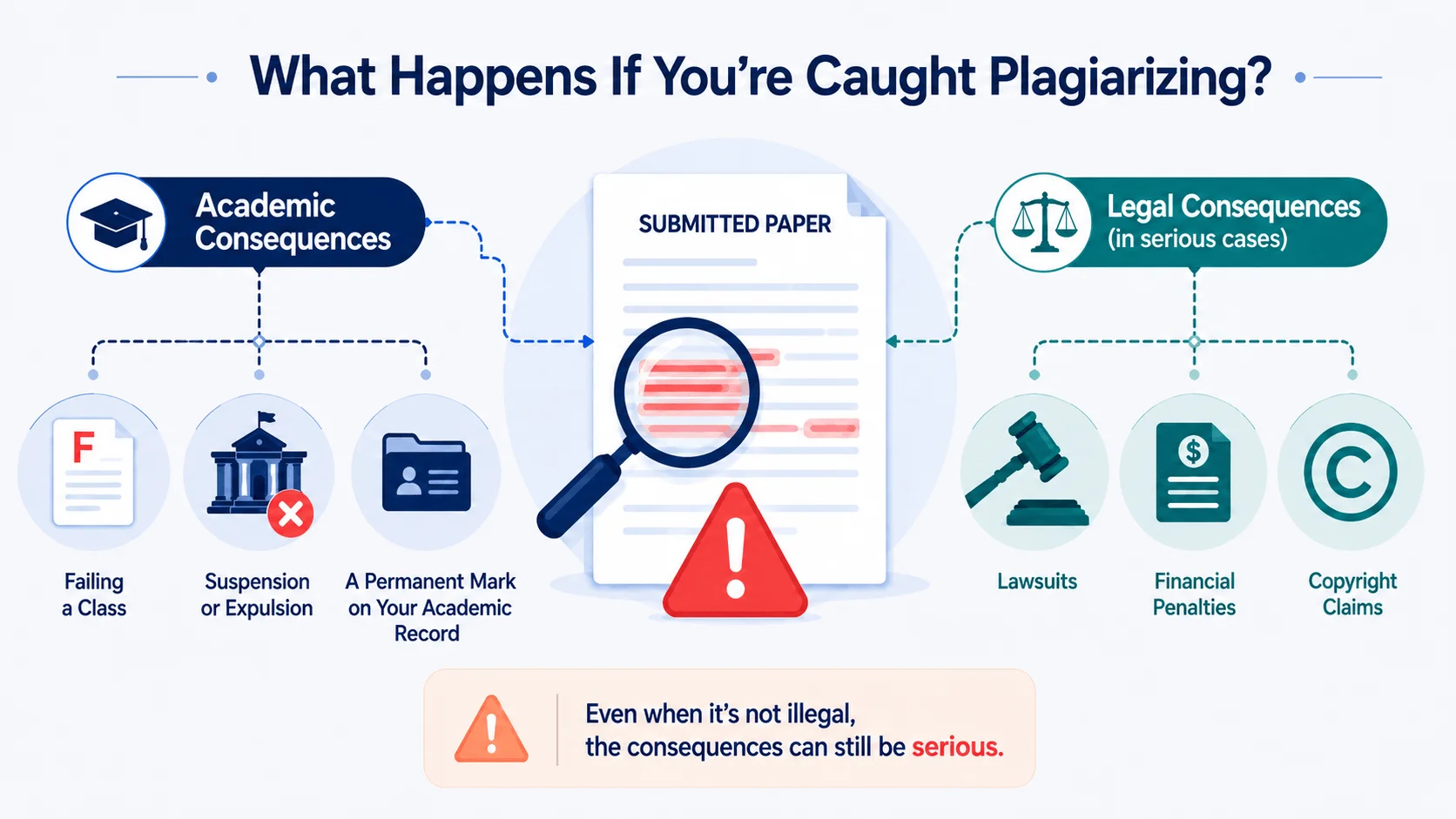
In academic and research settings, plagiarism is typically treated as a violation of integrity and authorship standards. Common consequences may include:
Failing a class or assignment
Suspension or expulsion
Retraction of published work
Loss of research funding or academic opportunities
A permanent mark on an academic or professional record
Legal Consequences (in More Serious Cases)
Although plagiarism is not always illegal, legal issues may arise when copyrighted or protected material is involved. Potential consequences can include:
Copyright infringement claims
Financial penalties or settlements
Lawsuits related to intellectual property misuse
Even when no legal action occurs, plagiarism can still lead to significant reputational and professional consequences.
Is AI-Generated Content Considered Plagiarism?
AI-generated content is not automatically considered plagiarism. Simply using AI tools to help brainstorm, draft, or refine ideas does not violate rules by itself. In fact, many students now use AI as part of their writing process.
However, it becomes risky when:
Used without editing
Submitting raw AI-generated text without revision may result in unoriginal or improperly sourced content.
It mimics someone’s original work
If the output closely resembles existing published material, it may raise both plagiarism and copyright concerns.
It lacks proper attribution
When ideas, data, or references are included without citation, the content may still be flagged as plagiarism.
This is where many students get into trouble without realizing it.
How to Avoid Plagiarism (Practical Tips)
Avoiding plagiarism is less about memorizing strict rules and more about developing consistent, transparent writing habits throughout the research and drafting process.
In many cases, plagiarism concerns arise not from intentional copying, but from rushed paraphrasing, unclear note-taking, or improper source integration. A few practical habits can significantly reduce these risks while also improving the overall quality of academic writing.
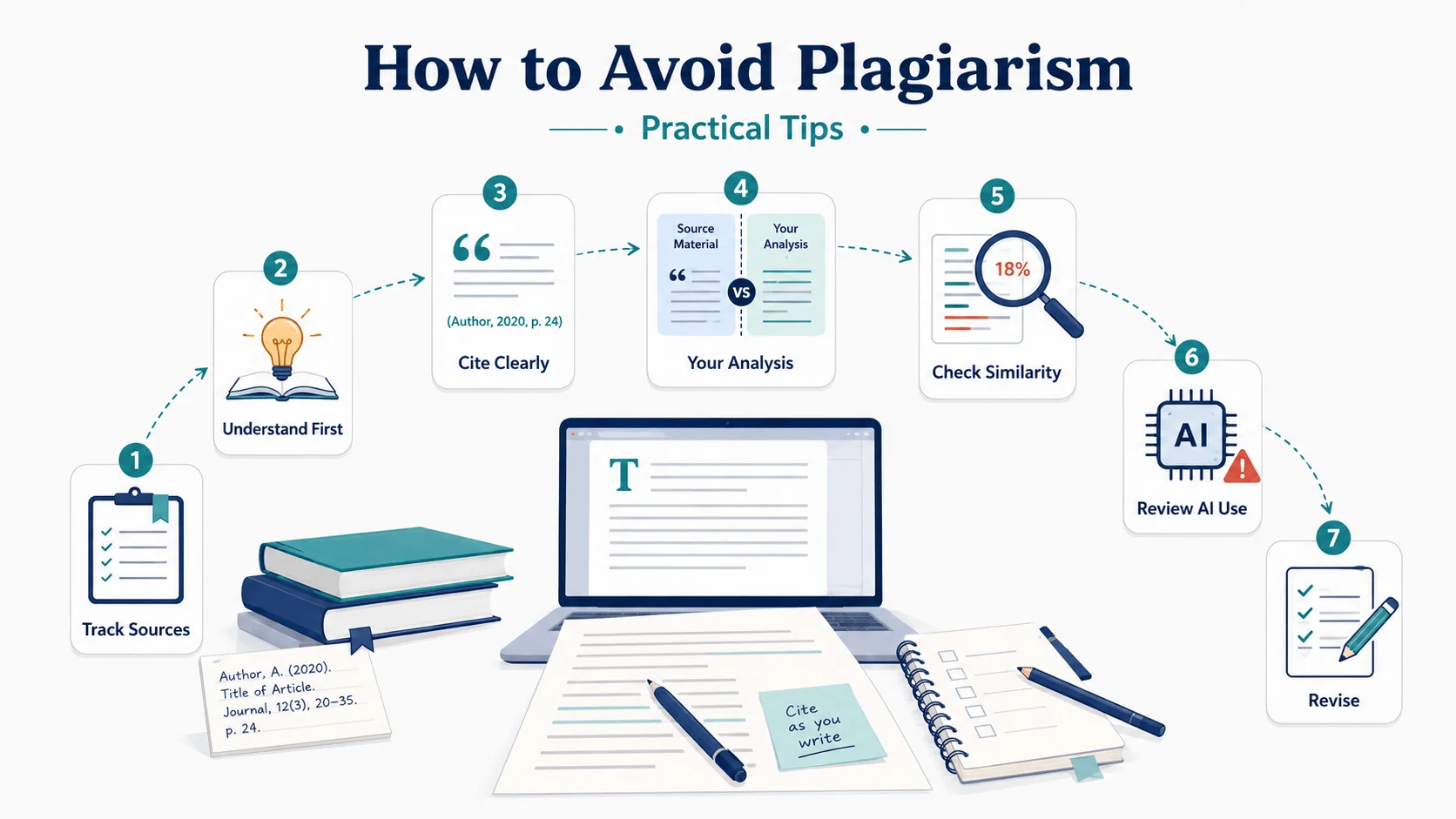
Keep track of sources while researching
Record citations, page numbers, and reference details early to avoid losing source information during drafting or revision.
Focus on understanding before paraphrasing
Instead of rewriting sentences word by word, first understand the original idea and then explain it in your own structure and academic voice.
Use citations consistently
When ideas, arguments, data, or wording originate from another source, provide clear attribution even if the material has been paraphrased.
Distinguish your analysis from source material
Make sure readers can clearly identify which ideas come from existing literature and which reflect your own interpretation or contribution.
Review similarity before submission
Running a plagiarism or similarity check before submission can help identify passages that remain too close to source material.
Be cautious with AI-assisted writing
AI-generated content may unintentionally reproduce existing phrasing or create unclear authorship boundaries, so careful review and editing remain essential.
Allow time for revision
Plagiarism risks often increase when writing is rushed. Leaving time to revise citations, paraphrasing, and source integration can make a significant difference.
Final Verdict: Is Plagiarism Illegal?
So, is plagiarism illegal? In most cases, the answer is no—it is typically treated as an academic or ethical issue rather than a legal one. Schools, universities, and institutions handle plagiarism through their own policies and disciplinary systems.
However, plagiarism can become illegal depending on the context. When it involves copyrighted material, financial gain, or intentional misrepresentation, it may cross into legal territory and lead to serious consequences beyond academics.
The key takeaway is simple: even if plagiarism doesn’t always break the law, it can still have lasting academic, professional, and reputational consequences.
Plagiarism is always risky—even when it’s not illegal.
FAQ
Can you go to jail for plagiarism?
In most cases, no. Plagiarism itself usually does not lead to jail time. However, if it involves copyright infringement, fraud, or large-scale financial harm, legal action could escalate, though jail is still rare.
Is plagiarism a crime in college?
Plagiarism is not typically considered a crime in college, but it is a serious academic violation. Students may face penalties such as failing grades, suspension, or expulsion.
Is copying homework illegal?
Copying homework is generally not illegal, but it is considered academic dishonesty. Schools may penalize it, even though it does not usually involve legal consequences.
How much plagiarism is allowed?
There is no universal “allowed” amount. Even small amounts of uncredited content can be flagged. Most institutions expect original work with proper citations, regardless of percentage.