

Is Using AI Plagiarism? The Line You Don’t Want to Cross

Let’s be real for a second.
You’ve got a deadline coming up. You open up an AI tool, type in your prompt, and within seconds… you’ve got something that actually sounds pretty solid. Maybe even better than what you would’ve written under pressure.
And then that little voice kicks in:
“Wait… is this plagiarism?”
It’s not like you copied it from a website.
You didn’t steal it from a classmate.
So technically… you’re fine, right?
Well, not exactly.
This is where things get messy. Because using AI doesn’t fit neatly into the usual “cheating vs not cheating” box. It’s not a clear yes or no—and that’s exactly why so many people feel unsure about it.
So… What Counts as Plagiarism (in the First Place)?
Before discussing artificial intelligence, it’s important to clarify what plagiarism really means—because most people assume it’s much simpler than it actually is.
At its core, plagiarism is not just about copying and pasting text. It refers to using someone else’s words, ideas, or intellectual work without proper acknowledgment, and presenting them as your own. This can happen intentionally, but it can also occur unintentionally when sources are not properly cited or understood.
The most obvious form of plagiarism is direct copying. However, plagiarism takes several different forms in practice, many of which are less obvious but equally important to understand.
Common Types of Plagiarism
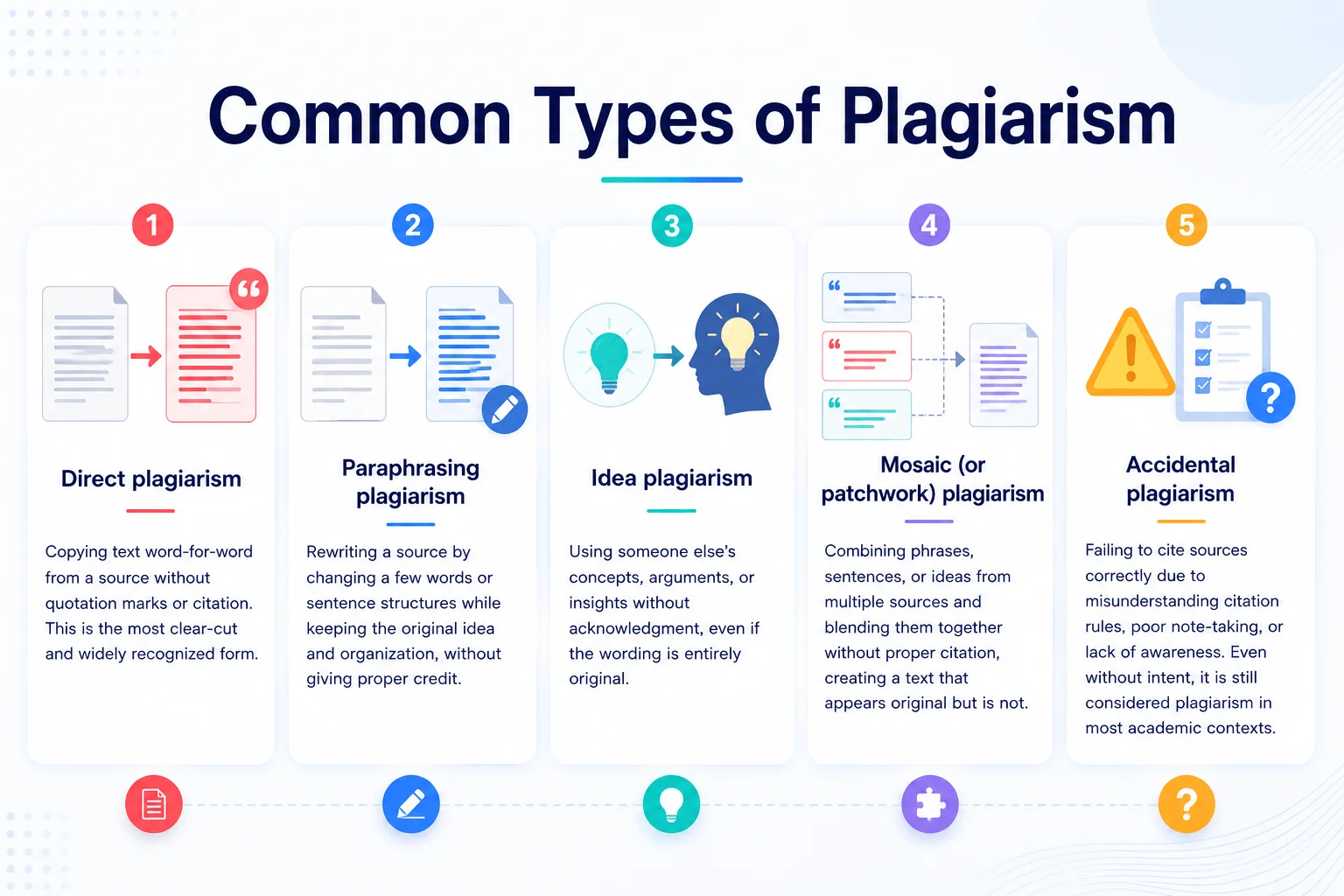
Direct plagiarism
Copying text word-for-word from a source without quotation marks or citation. This is the most clear-cut and widely recognized form.Paraphrasing plagiarism
Rewriting a source by changing a few words or sentence structures while keeping the original idea and organization, without giving proper credit.Idea plagiarism
Using someone else’s concepts, arguments, or insights without acknowledgment, even if the wording is entirely original.Mosaic (or patchwork) plagiarism
Combining phrases, sentences, or ideas from multiple sources and blending them together without proper citation, creating a text that appears original but is not.Accidental plagiarism
Failing to cite sources correctly due to misunderstanding citation rules, poor note-taking, or lack of awareness. Even without intent, it is still considered plagiarism in most academic contexts.
Understanding these distinctions is important, because plagiarism is not defined solely by how the text looks on the surface. It is ultimately about ownership, attribution, and transparency.
This also explains why the concept becomes more complex when AI is involved, as AI-generated content does not fit neatly into these traditional categories.
Why AI Makes This So Confusing
AI kind of breaks the old rules.
When you use a source—like a book, an article, or even Wikipedia—you’re pulling from something that already exists. That’s why citations matter.
But AI doesn’t give you a link to a source. It generates something new, on the spot, based on patterns it’s learned from massive amounts of data.
So now you’ve got content that:
wasn’t directly copied from anywhere
but also didn’t come from your own thinking
And that creates a weird middle ground.
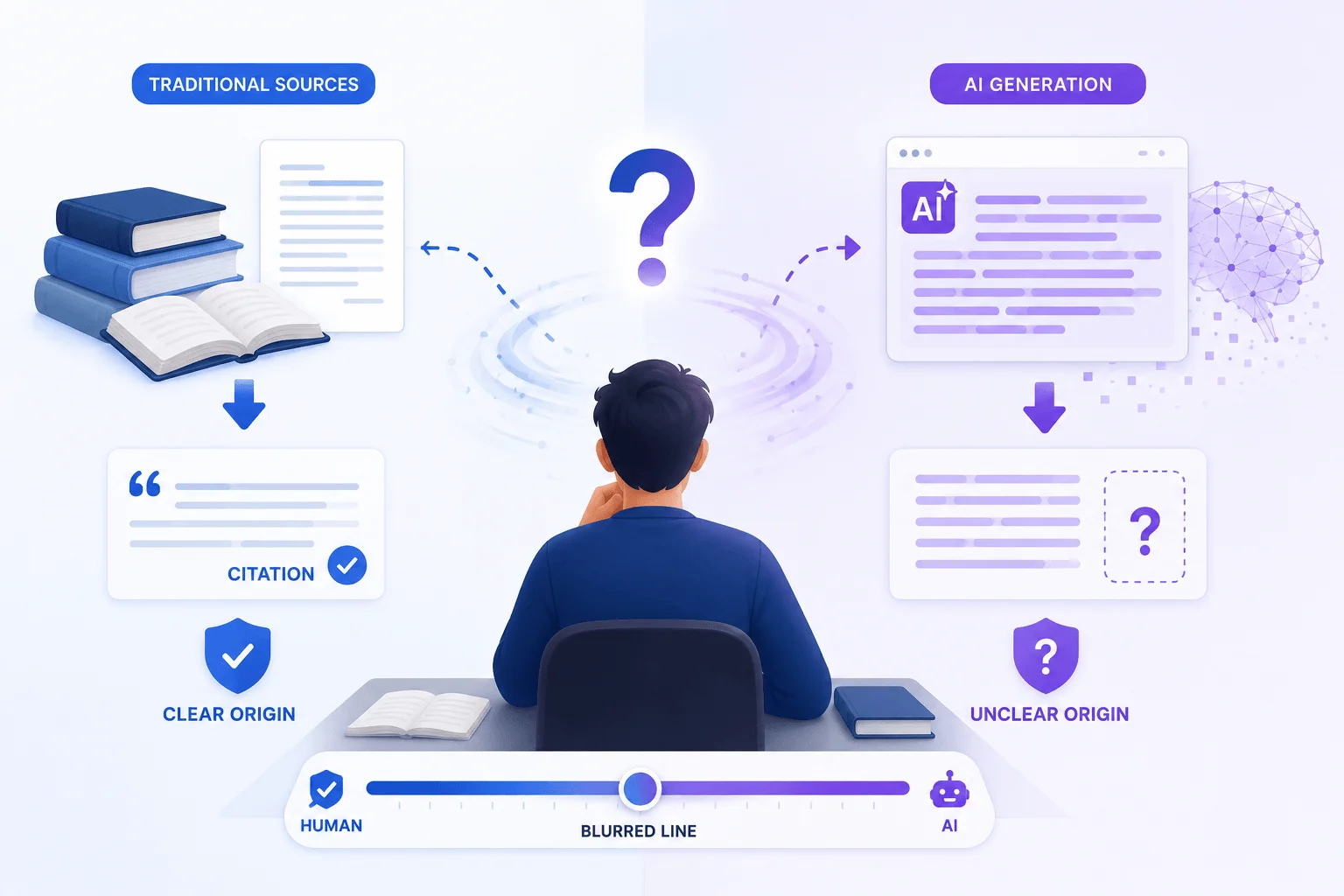
On one hand, you’re not “stealing” in the traditional sense. On the other hand, you didn’t fully create it either.
That’s why people often say: AI blurs the line between assistance and authorship.
And once that line gets blurry, it becomes a lot harder to answer a simple question like “Is this plagiarism?”—because now, it depends on how you’re actually using the tool.
When Using AI Can Be Considered Plagiarism
So where does AI actually cross the line?
It usually happens when the tool stops being a helper… and starts doing the thinking for you.
For example, if you generate a full response with AI and submit it as-is, that’s where things get risky. Not because you copied it from a specific source, but because you’re presenting something as your own work that you didn’t really create or process.
The same goes for situations where:
the entire structure, argument, and wording come from AI
you haven’t actually read or understood what you’re submitting
you rely on AI to “handle it” instead of engaging with the topic
At that point, the issue isn’t just plagiarism in the traditional sense—it’s about academic integrity. You’re claiming ownership of something that doesn’t reflect your own understanding.
And that’s exactly what many institutions care about most.
When It’s Probably Not Plagiarism (But Still Needs Care)
On the flip side, not every use of AI is a problem.
In fact, a lot of people use AI in ways that are pretty similar to other writing tools—and that’s generally fine, as long as you stay in control of the work.
Think of AI as something that can support your process, not replace it.
For example, it’s usually safe to:
use AI to brainstorm ideas when you’re stuck
ask it to rephrase a sentence you’ve already written
get help with grammar, clarity, or flow
The key difference here is that you’re still the one doing the thinking. You understand the content, you make the decisions, and you shape the final result.
That’s what keeps the work yours.
But even in these “safe” scenarios, there’s still a line. If your writing starts to sound less like you and more like something generated, it can raise questions—even if that wasn’t your intention.
Because of this growing gray area, many schools and institutions have started introducing AI detection alongside traditional plagiarism checks. The goal isn’t just to see whether something was copied, but also to better understand how the work was created in the first place.
AI Detection vs. Plagiarism Detection: Are They the Same Thing?
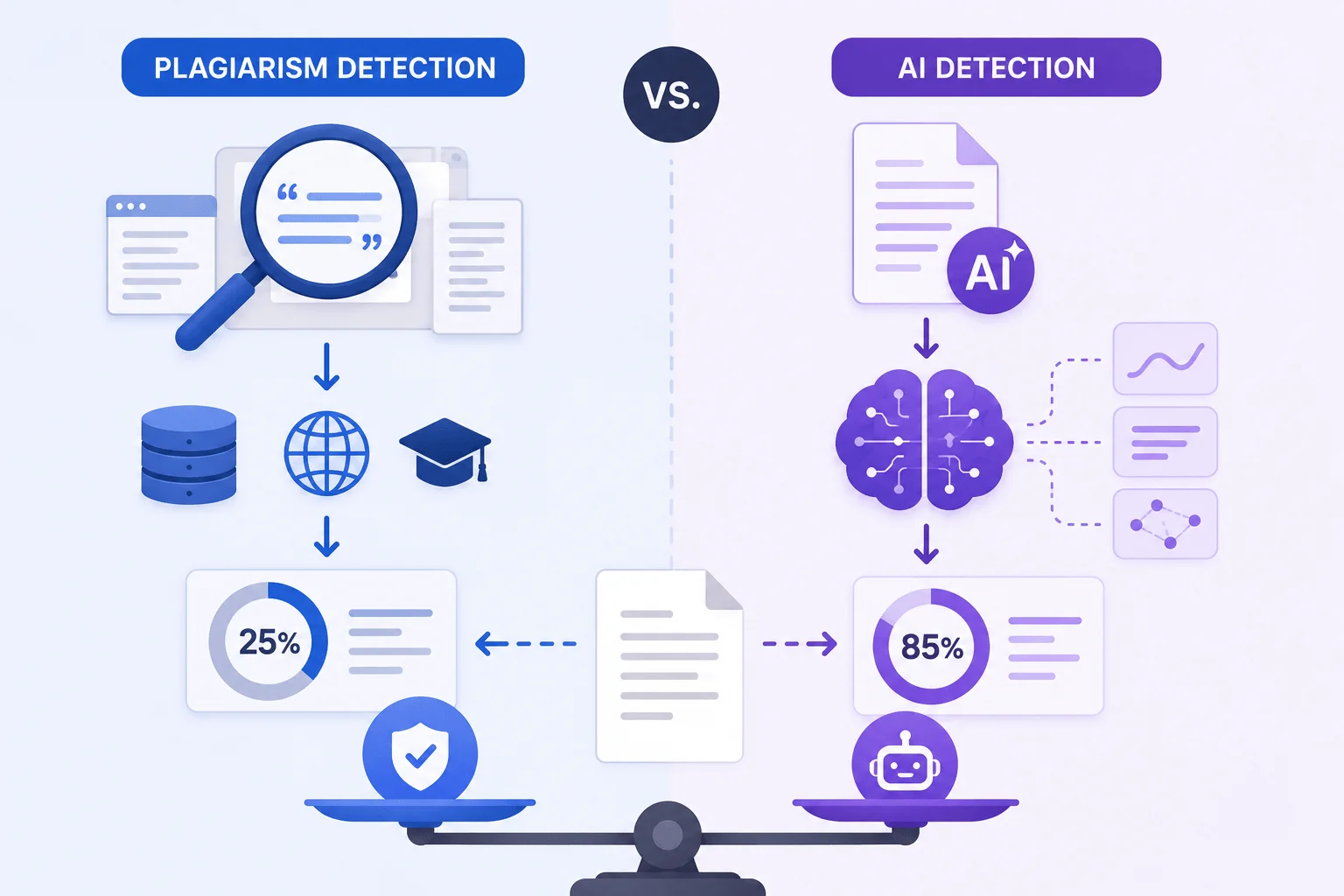
Although they are often mentioned together, AI detection and plagiarism detection are designed to answer two very different questions.
Plagiarism detection focuses on similarity. It compares your writing against existing sources such as academic databases, websites, and previously submitted papers. Tools like Turnitin or other similarity checkers highlight matching text and generate a similarity score to indicate how much of the content overlaps with known sources.
AI detection, on the other hand, looks at writing patterns. Instead of matching text to sources, it analyzes factors like sentence structure, predictability, and language patterns to estimate whether a piece of writing is likely to have been generated by AI. Many modern platforms now include this feature as part of their review process.
This means a piece of writing can have:
Low similarity (not copied from any source)
but still show a high likelihood of AI generation
That distinction is important. AI-generated content is not necessarily plagiarized in the traditional sense, but it can still raise concerns about authorship and originality.
What Schools and Tools Are Actually Looking For
With both types of detection in place, the focus has shifted beyond simply identifying copied content.
Most institutions are ultimately looking for three things:
Originality
Whether the content is distinct and not overly similar to existing sources.
Authorship
Whether the writing reflects the individual’s own thinking, rather than being fully generated or assembled externally.
Consistency
Whether the tone, style, and level of writing remain consistent throughout the work, rather than shifting in a way that suggests outside assistance.
This is why a paper can pass a plagiarism check but still be questioned, or why AI detection alone doesn’t automatically mean a violation. Each signal provides context, but neither tells the full story on its own.
How to Use AI Without Crossing the Line
The safest way to use AI is pretty simple: treat it like a smart assistant, not a ghostwriter.
That means using it to support your process—not replace it.
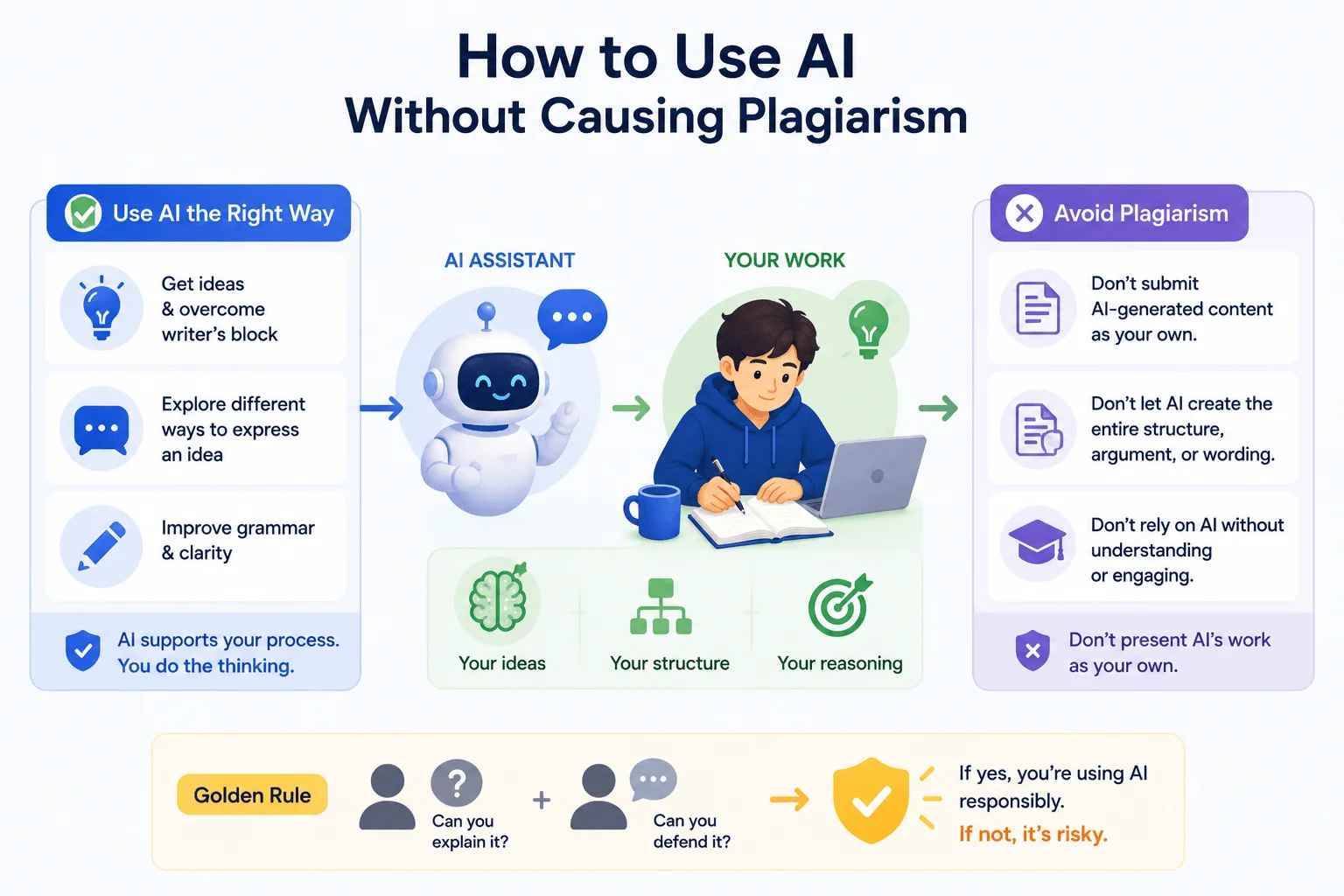
For example, you might:
use it to get unstuck when you’re staring at a blank page
ask for alternative ways to phrase something you already understand
clean up grammar or improve clarity after you’ve written a draft
But the core ideas? The structure? The reasoning?
That should still come from you.
A good rule of thumb is this:
If you can’t explain what you wrote—or defend it if someone asks—you probably relied on AI a little too much.
Final Take: It’s Less About AI — More About Ownership
So… is using AI plagiarism?
The most honest answer is: it depends on how you use it.
AI itself isn’t the problem. It’s a tool.
What matters is whether the final work actually represents your thinking.
If you’re using AI to support your ideas, clarify your writing, and improve your process—you’re probably on solid ground.
But if you’re handing over the thinking, the structure, and the wording entirely… that’s where things start to fall apart.
At the end of the day, this isn’t just about rules or detection tools.
It’s about ownership.
AI can absolutely help you write faster, cleaner, and more confidently.
But it shouldn’t replace the one thing your work is supposed to show:
your ideas.