

Patchwork Plagiarism: Examples, Risks & Prevention

Patchwork plagiarism is more common in academic writing than many researchers realize. Because the text is partially paraphrased rather than directly copied, it is often mistaken as acceptable rewriting.
However, similarity detection tools and journal editors are increasingly effective at identifying these patterns. Even small sections of poorly attributed or heavily borrowed language can raise concerns during peer review or publication screening.
Understanding how patchwork plagiarism happens—and how to avoid it—is essential for protecting both research credibility and publication integrity.

What Is Patchwork Plagiarism?
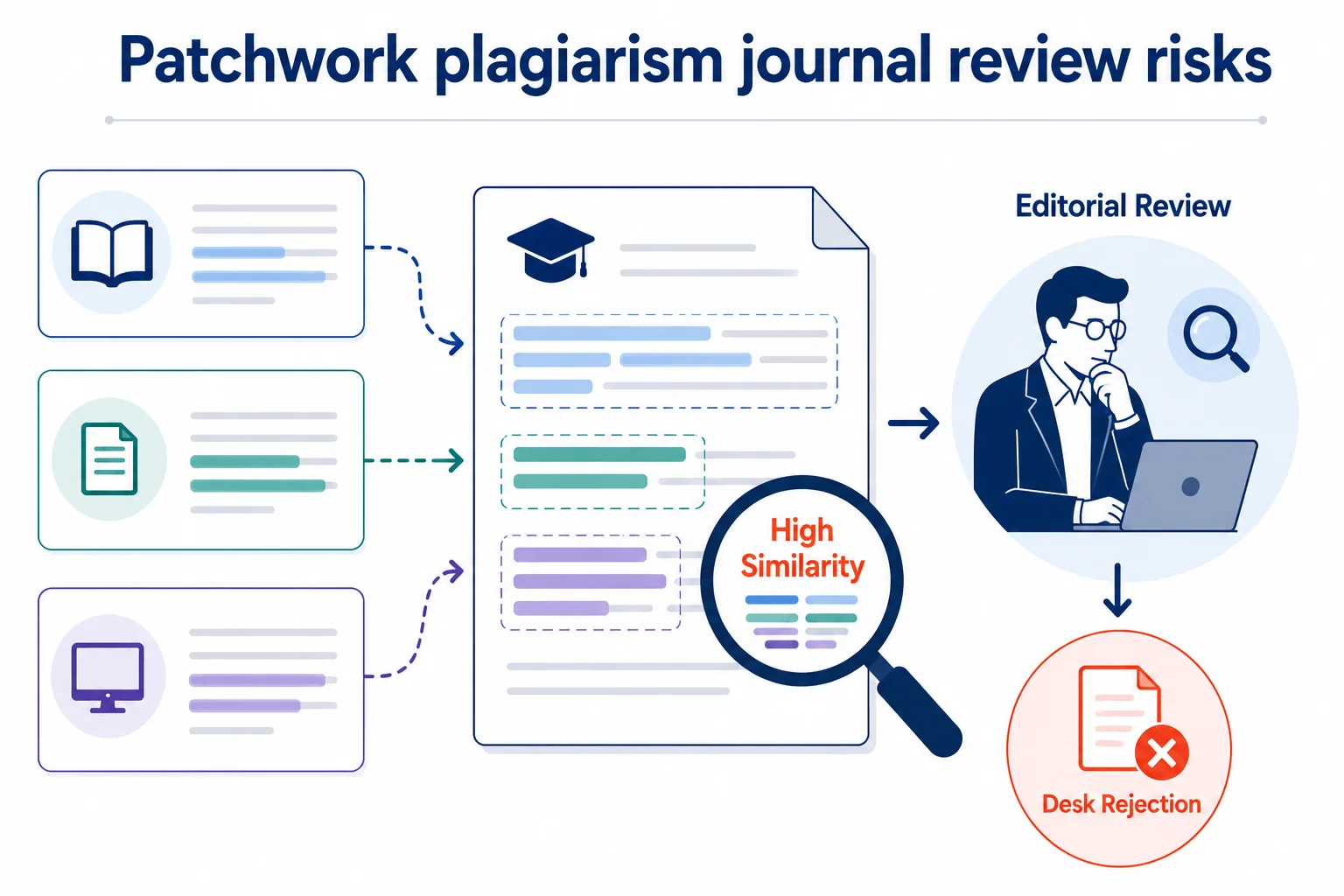
Patchwork plagiarism, also called mosaic plagiarism, happens when a writer combines phrases, sentences, or ideas from multiple sources without proper attribution. Instead of copying one entire passage, the writer “stitches together” content from different articles, papers, or websites and presents the final text as original writing.
Unlike direct plagiarism, which copies from a single source, patchwork plagiarism involves borrowing from multiple sources at the same time. Writers may slightly change wording, rearrange sentence structures, or merge ideas from different references to make the text appear original.
In academic writing, this often happens when researchers rely too heavily on published literature during drafting. Rather than fully rewriting ideas in their own voice, they combine borrowed material into a new paragraph without clear citation.
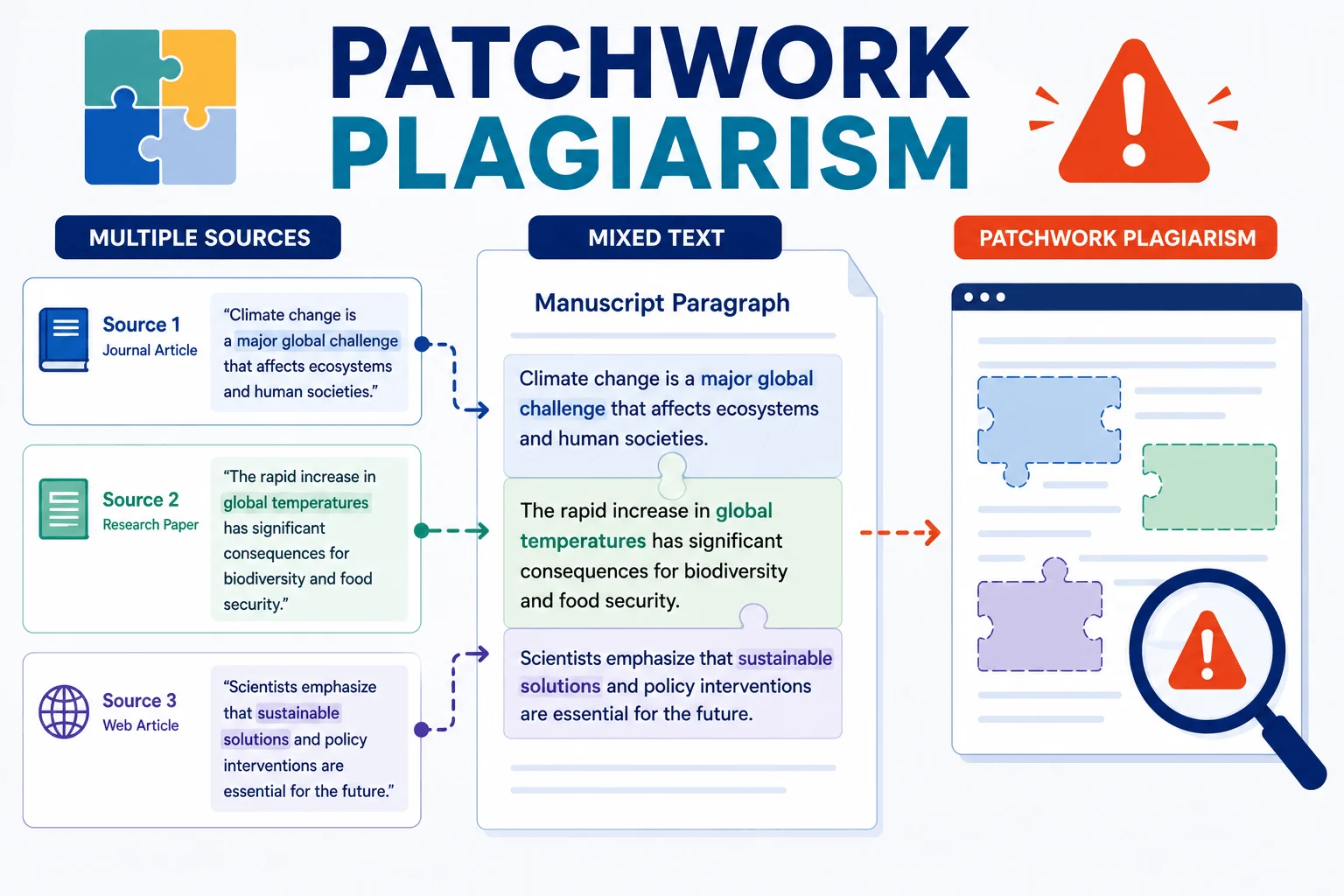
For example, a writer might:
Take one sentence from a journal article
Borrow terminology from another source
Rewrite phrases from a third paper
Merge everything into a single paragraph without attribution
Even if no full paragraph is copied directly, the final text is still considered plagiarism because the writing relies heavily on uncited source material.
Because patchwork plagiarism can appear less obvious than direct copying, many researchers do not recognize it immediately in their own writing. Looking at real examples is often the easiest way to understand how it appears in academic manuscripts.
Common Examples of Patchwork Plagiarism
Below are several common examples frequently seen in journal submissions and literature reviews.
1. Rewriting Sentences With Minimal Word Changes
One of the clearest forms of patchwork plagiarism is changing vocabulary while preserving the original sentence structure and argument flow.
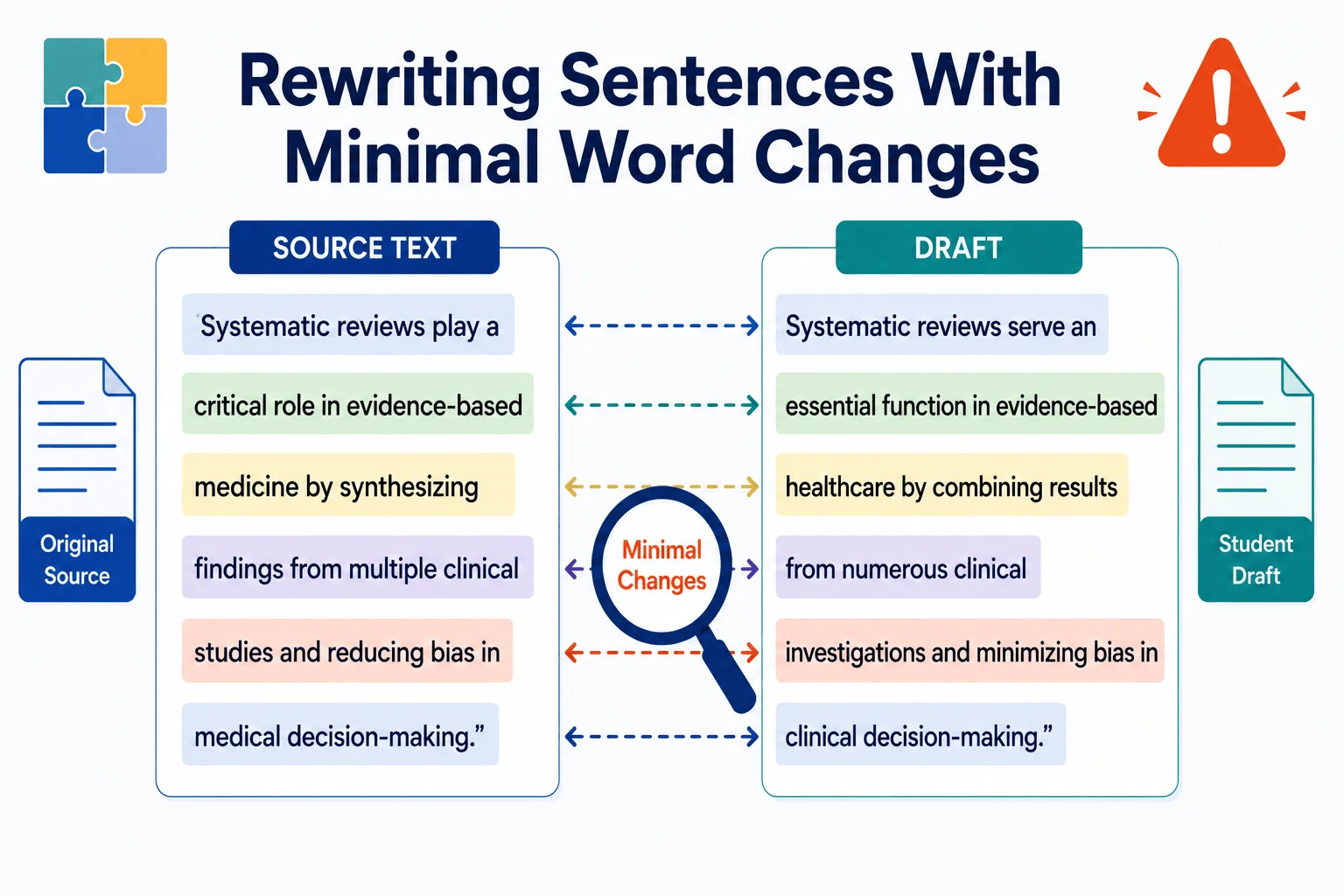
Source Text
“Systematic reviews play a critical role in evidence-based medicine by synthesizing findings from multiple clinical studies and reducing bias in medical decision-making.”
Draft
“Systematic reviews serve an essential function in evidence-based healthcare by combining results from numerous clinical investigations and minimizing bias in clinical decision-making.”
Explanation
Although several terms were replaced with synonyms, the sentence organization, logic, and phrasing pattern remain substantially similar to the original source. This type of “sentence skeleton” copying is still considered patchwork plagiarism because the rewritten text depends heavily on the source author’s expression rather than presenting an independently written interpretation.
2. Stitching Together Multiple Published Sources
Patchwork plagiarism often appears when researchers combine fragments from several papers into one literature review paragraph.
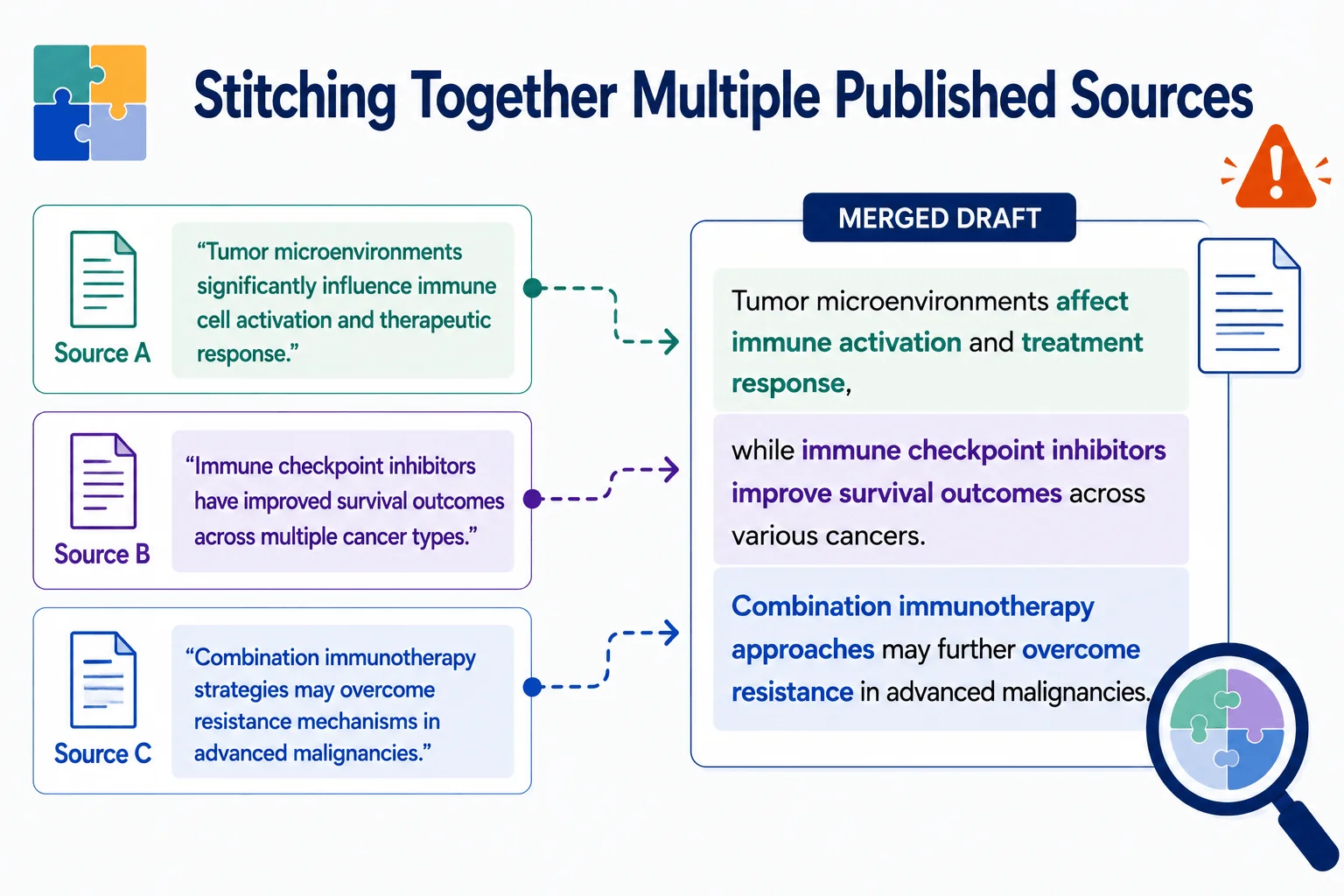
Source Text
Source A: “Tumor microenvironments significantly influence immune cell activation and therapeutic response.”
Source B: “Immune checkpoint inhibitors have improved survival outcomes across multiple cancer types.”
Source C: “Combination immunotherapy strategies may overcome resistance mechanisms in advanced malignancies.”
Draft
“Tumor microenvironments affect immune activation and treatment response, while immune checkpoint inhibitors improve survival outcomes across various cancers. Combination immunotherapy approaches may further overcome resistance in advanced malignancies.”
Explanation
The draft merges sentence structures and specialized phrasing from multiple published sources with minimal independent synthesis. Even though no single passage was copied completely, the paragraph functions as a mosaic of existing literature. This problem is particularly common in review articles where authors summarize sources too closely instead of generating original synthesis.
3. Overusing Source Language in Notes and Drafts
Many cases of patchwork plagiarism begin during the note-taking stage of manuscript preparation.
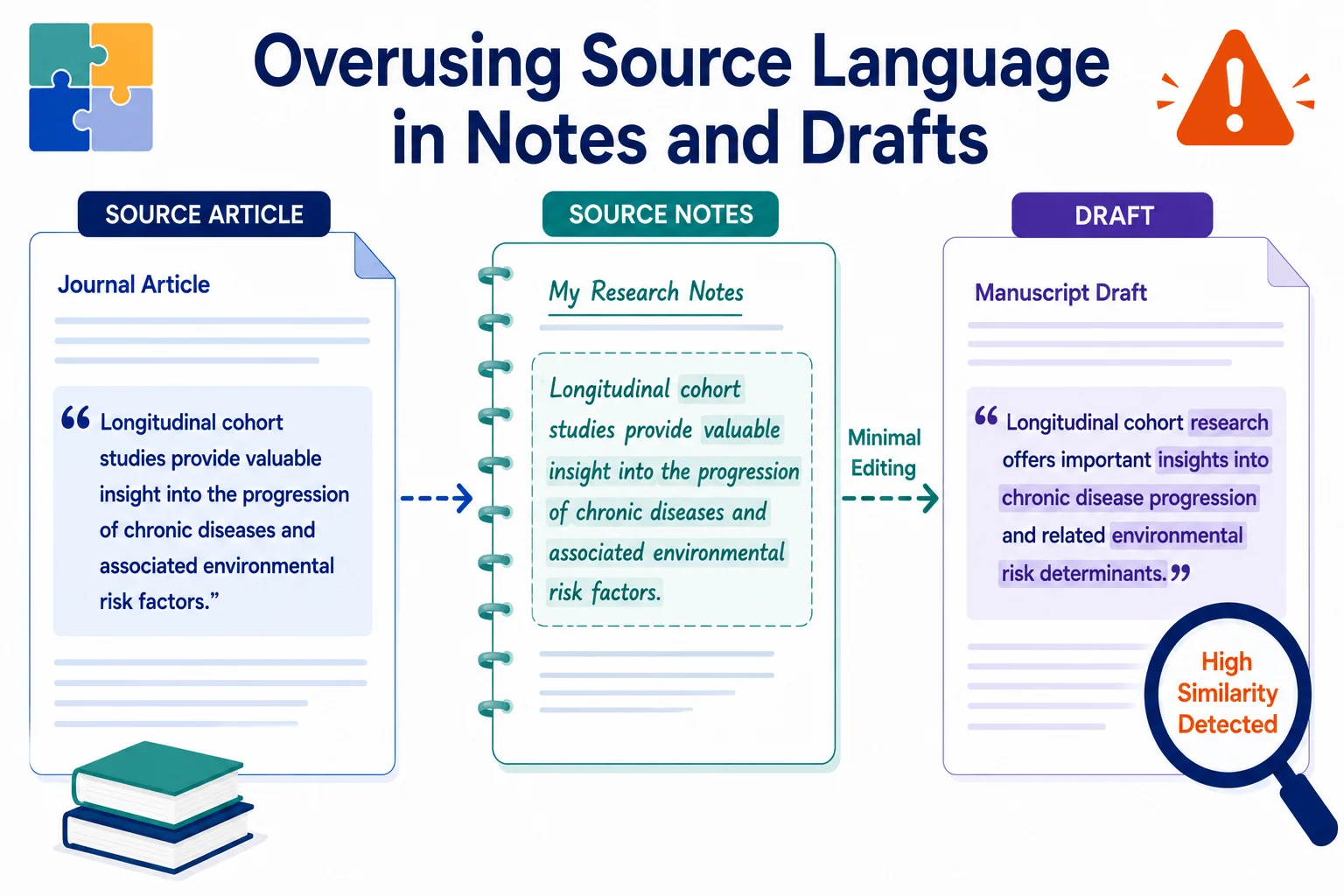
Source Text
“Longitudinal cohort studies provide valuable insight into the progression of chronic diseases and associated environmental risk factors.”
Draft
“Longitudinal cohort research offers important insights into chronic disease progression and related environmental risk determinants.”
Explanation
Researchers often copy technically precise sentences into notes while reading journal articles. During later revisions, those notes may receive only superficial editing before being inserted into the manuscript. Because scientific terminology and sentence structure remain highly similar, plagiarism detection systems may still flag the passage as improperly paraphrased source material.
4. AI-Assisted Paraphrasing Problems
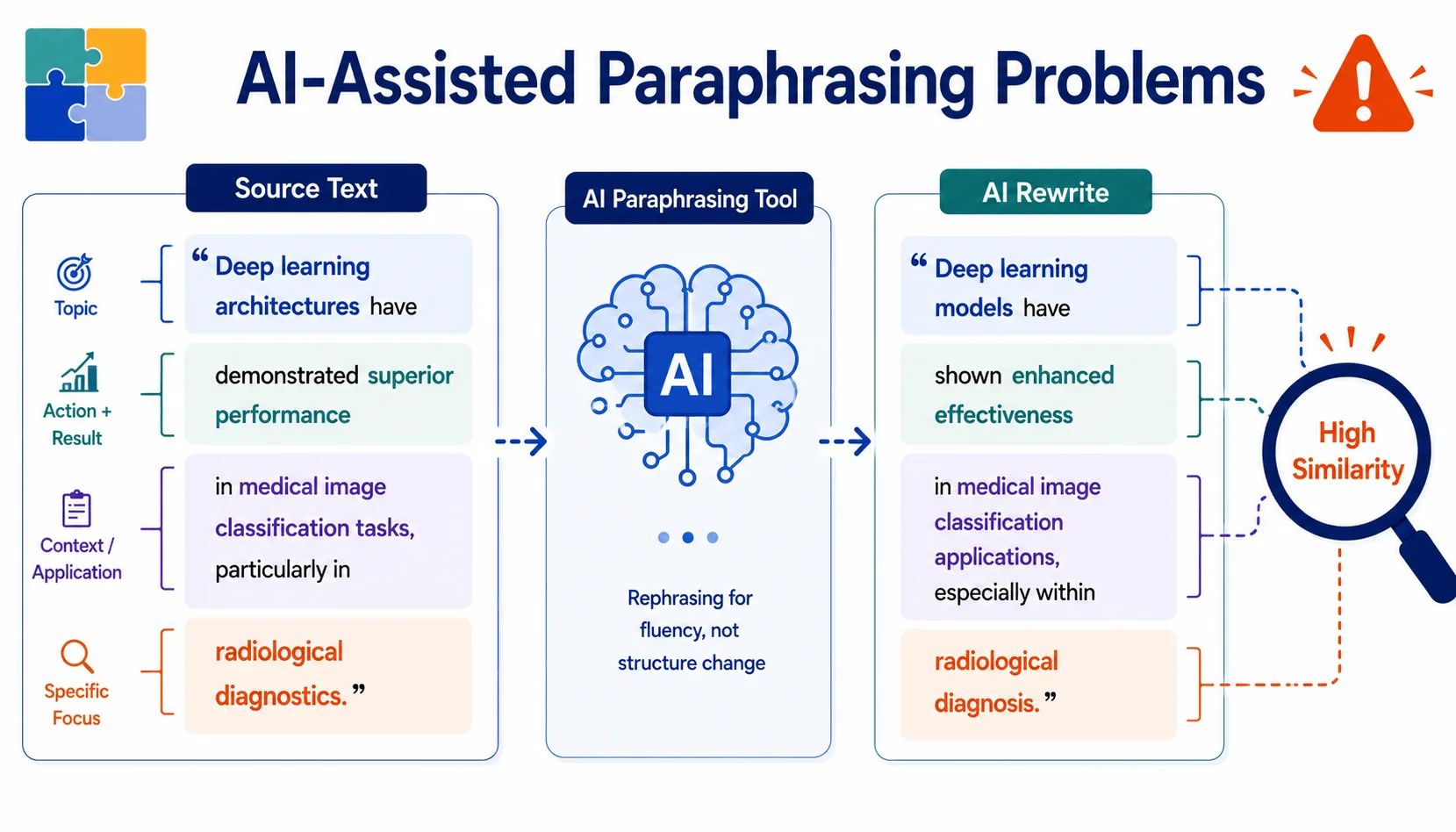
AI paraphrasing tools can unintentionally produce patchwork plagiarism by preserving the original logical structure of source text.
Source Text
“Deep learning architectures have demonstrated superior performance in medical image classification tasks, particularly in radiological diagnostics.”
Draft
“Deep learning models have shown enhanced effectiveness in medical image classification applications, especially within radiological diagnosis.”
Explanation
The rewritten sentence changes surface vocabulary but closely follows the original wording pattern and semantic structure. Many AI-assisted rewrites create this type of similarity because the system optimizes for fluency rather than true conceptual reformulation. As a result, AI-generated paraphrases may still trigger plagiarism concerns during journal screening and peer review.
Why Patchwork Plagiarism Is Risky in Academic Publishing
Journals Evaluate More Than Citations
Adding references does not automatically make reused text acceptable. Editors also assess whether authors express ideas independently.
If a manuscript closely follows the sentence structure, phrasing, or argument flow of published sources, it may still raise plagiarism concerns even when citations are included. Academic journals expect genuine synthesis rather than lightly modified source language.
Similarity Detection Is Becoming More Sophisticated
Modern plagiarism detection systems analyze more than exact word matches. Many tools now identify:
Structural similarity
Semantic overlap
Repetitive phrasing patterns
AI-assisted paraphrasing signals
Editorial reviewers may also recognize patchwork writing manually, especially in specialized disciplines where common source materials are familiar.
Possible Consequences for Researchers
Patchwork plagiarism may lead to:
Revision requests
Desk rejection
Additional ethics review
Publication delays
Damage to scholarly credibility
In more serious cases, journals may issue corrections or article retractions after publication.
Prevention Strategies for Avoiding Patchwork Plagiarism
Separate Research Reading From Writing
Writing while reading source papers often leads to unconscious copying of sentence structure and phrasing. Instead, researchers should first process the idea, then draft independently afterward. This helps reduce source-dependent writing.
Write From Understanding Instead of Source Text
Strong academic writing comes from interpretation rather than sentence-level rewriting.
Instead of focusing on how a study is written, focus on:
What the findings mean
How they connect to other studies
Why they matter within the field
This naturally produces more original writing.
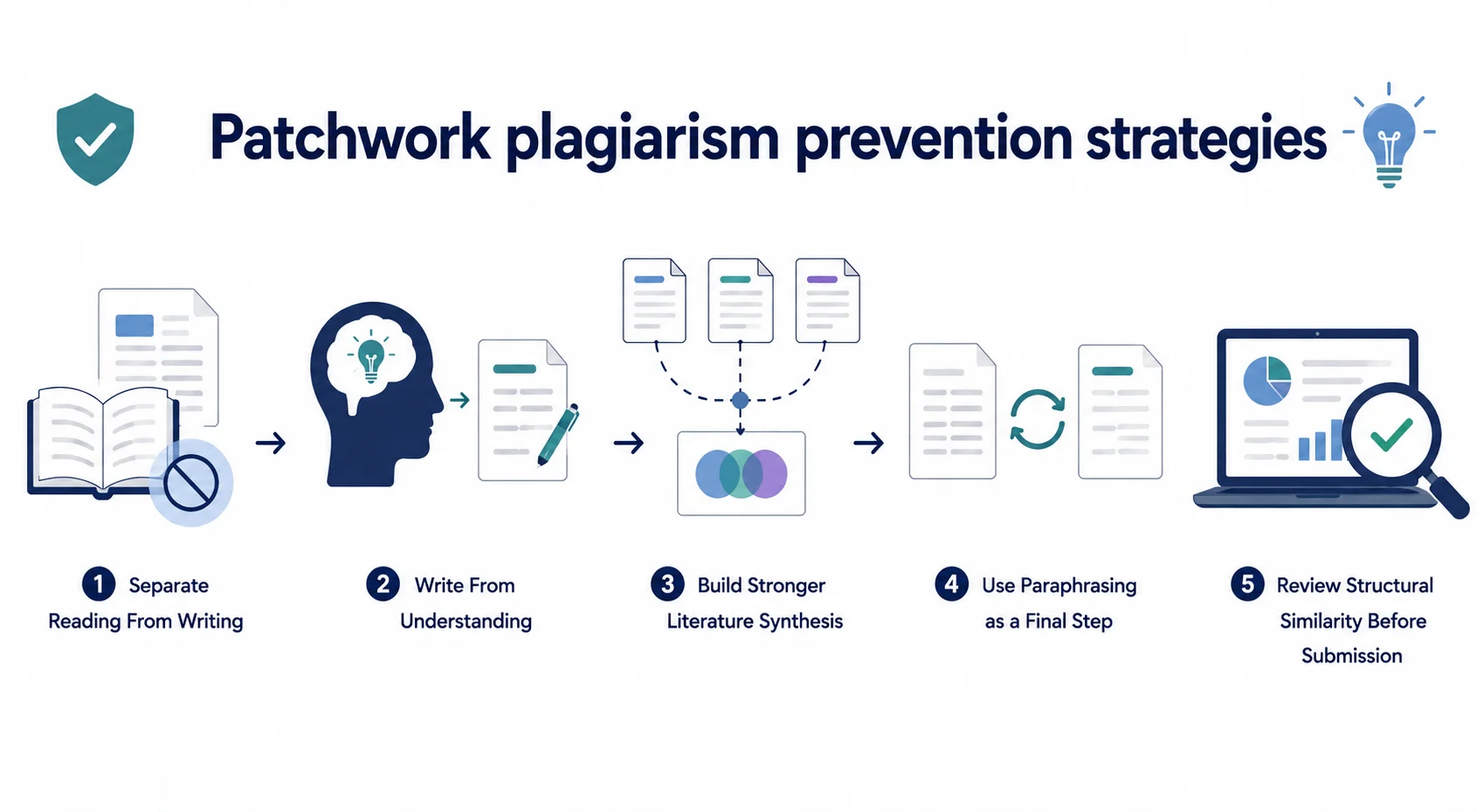
Build Stronger Literature Synthesis Skills
Patchwork plagiarism commonly appears in literature reviews that summarize studies one by one. A stronger approach is thematic synthesis:
Compare studies across themes or methods
Highlight similarities and contradictions
Build an independent analytical narrative
This reduces overreliance on source wording.
Use Paraphrasing as a Final Step, Not a Drafting Method
Excessive paraphrasing often preserves the structure and logic of the original text. Instead of rewriting sentences immediately, researchers should first develop their own interpretation and argument structure.
Review Structural Similarity Before Submission
Today, plagiarism screening is widely used across universities, publishers, journals, and other institutions that evaluate research submissions. In addition to manual editorial review, most institutions rely on professional similarity detection systems to help identify overlapping text, source-dependent phrasing, and structural similarity patterns.
One of the most widely used systems is iThenticate, which compares manuscripts against large scholarly databases and is commonly integrated into journal submission and publisher review processes.
However, iThenticate may not always be practical for individual researchers because of its relatively high cost and the limited AI detection functionality available in personal-access versions. For this reason, some researchers use alternatives such as Thentify for pre-submission similarity screening. Thentify provides similarity reports designed to align closely with iThenticate-style outputs, making it a practical option for reviewing structural similarity before formal journal submission.

Final Thoughts
We have explored many different aspects of patchwork plagiarism throughout this guide, from its definition and common patterns to the ways it appears in academic writing and publication review.
Although patchwork plagiarism can be triggered more easily than many researchers expect, developing stronger research and writing habits can significantly reduce the risk over time. Hopefully, this guide has helped make the topic feel clearer and more manageable.
FAQ

What is the difference between patchwork plagiarism and direct plagiarism?
Direct plagiarism copies text verbatim, while patchwork plagiarism blends lightly modified language from multiple sources.
Can patchwork plagiarism happen even with citations?
Yes. Proper citation does not automatically make heavily imitated wording acceptable.
Why is patchwork plagiarism common in literature reviews?
Because researchers work with many sources simultaneously, making structural imitation more likely.
Do AI paraphrasing tools prevent patchwork plagiarism?
Not necessarily. Many tools preserve source structure and phrasing patterns too closely.
How can researchers avoid patchwork plagiarism?
Focus on independent synthesis, conceptual understanding, and analytical writing rather than sentence-level rewriting.