

What Is Mosaic Plagiarism? Examples, Risks & How to Avoid It

You’ve probably heard that copying text directly is plagiarism—but what about rewriting it?
Many writers assume that changing a few words is enough to make content original.
In reality, that assumption is exactly what leads to one of the most overlooked academic risks.
Mosaic plagiarism doesn’t look obvious, which is why it’s so easy to miss—and so frequently flagged. The challenge isn’t just avoiding copying, but understanding where the line actually is.
This article breaks down what mosaic plagiarism really looks like, why it matters, and how to avoid it with confidence.
What Is Mosaic Plagiarism?
Mosaic plagiarism—often called patchwork plagiarism—happens when you blend parts of a source into your writing without fully rewriting or properly citing them. It’s like stitching together someone else’s sentences or ideas to form your own paragraph.
What makes it confusing is that you’re not copying word for word. You might swap a few terms or slightly adjust phrasing, but the original structure and meaning remain largely the same. In academic standards, that still counts as plagiarism.
Many people fall into this trap because they assume paraphrasing simply means “changing a few words.” In reality, effective paraphrasing requires a deeper rewrite—one that reflects your own understanding, not just surface edits.
Still not sure what that looks like in practice? Let’s walk through some clear examples of mosaic plagiarism next.
Mosaic Plagiarism Examples
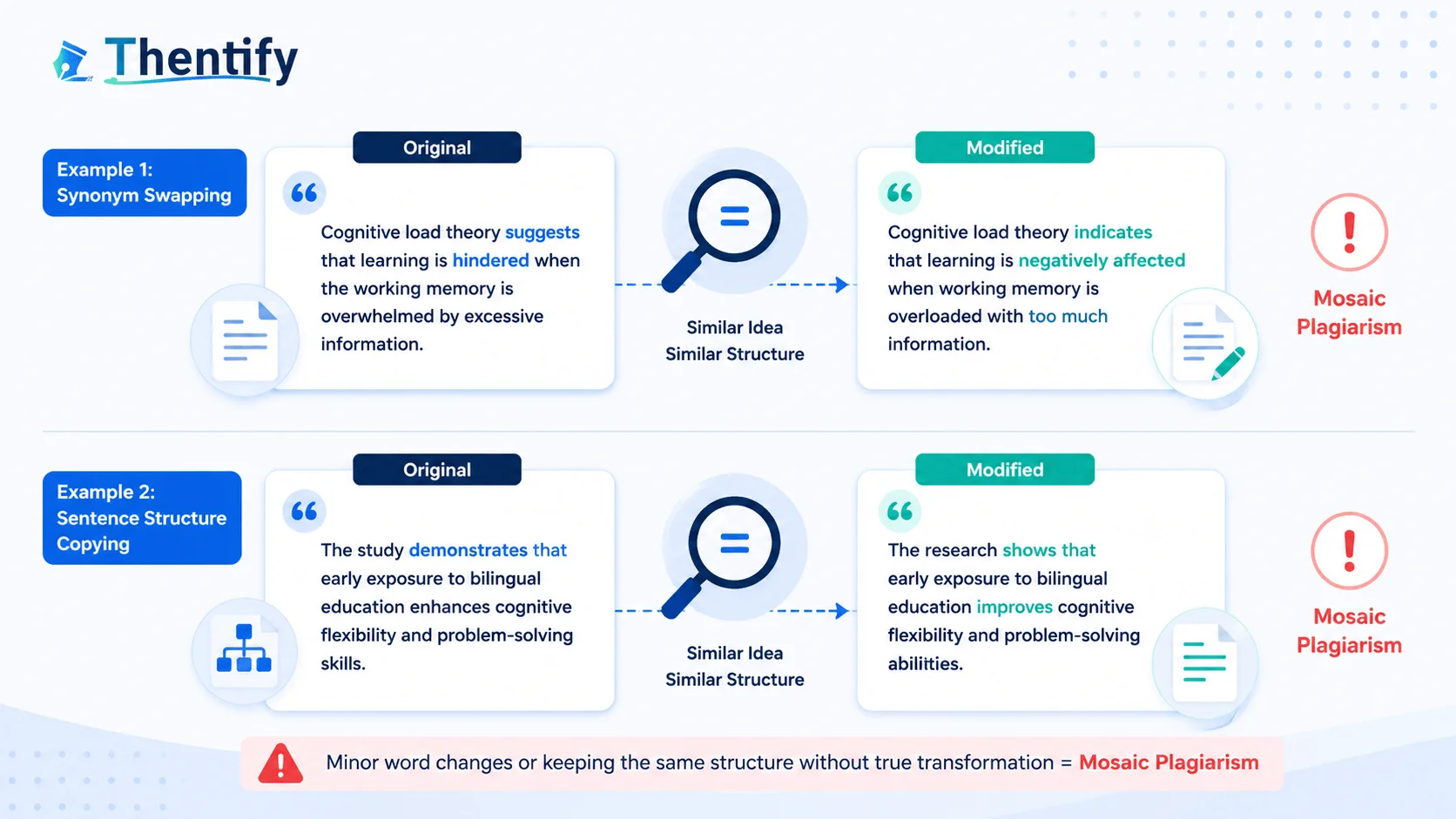
Example 1: Synonym Swapping
Original:
Cognitive load theory suggests that learning is hindered when the working memory is overwhelmed by excessive information.
Modified:
Cognitive load theory indicates that learning is negatively affected when working memory is overloaded with too much information.
While the wording has been slightly changed (“suggests” → “indicates,” “hindered” → “negatively affected”), the sentence structure and idea remain nearly identical. This is still mosaic plagiarism because the rewriting stays too close to the original expression without sufficient transformation.
Example 2: Sentence Structure Copying
Original:
The study demonstrates that early exposure to bilingual education enhances cognitive flexibility and problem-solving skills.
Modified:
The research shows that early exposure to bilingual education improves cognitive flexibility and problem-solving abilities.
Here, the sentence structure is preserved almost entirely, with only minor word substitutions. This type of copying is harder to notice because it appears polished and academic, but the underlying structure still mirrors the source—making it a form of mosaic plagiarism.
Example 3: Mixed Sources Without Citation
Original Sources:
Source A: Neuroplasticity allows the brain to reorganize itself in response to learning and experience.
Source B: Repeated practice strengthens neural pathways, leading to improved skill acquisition.
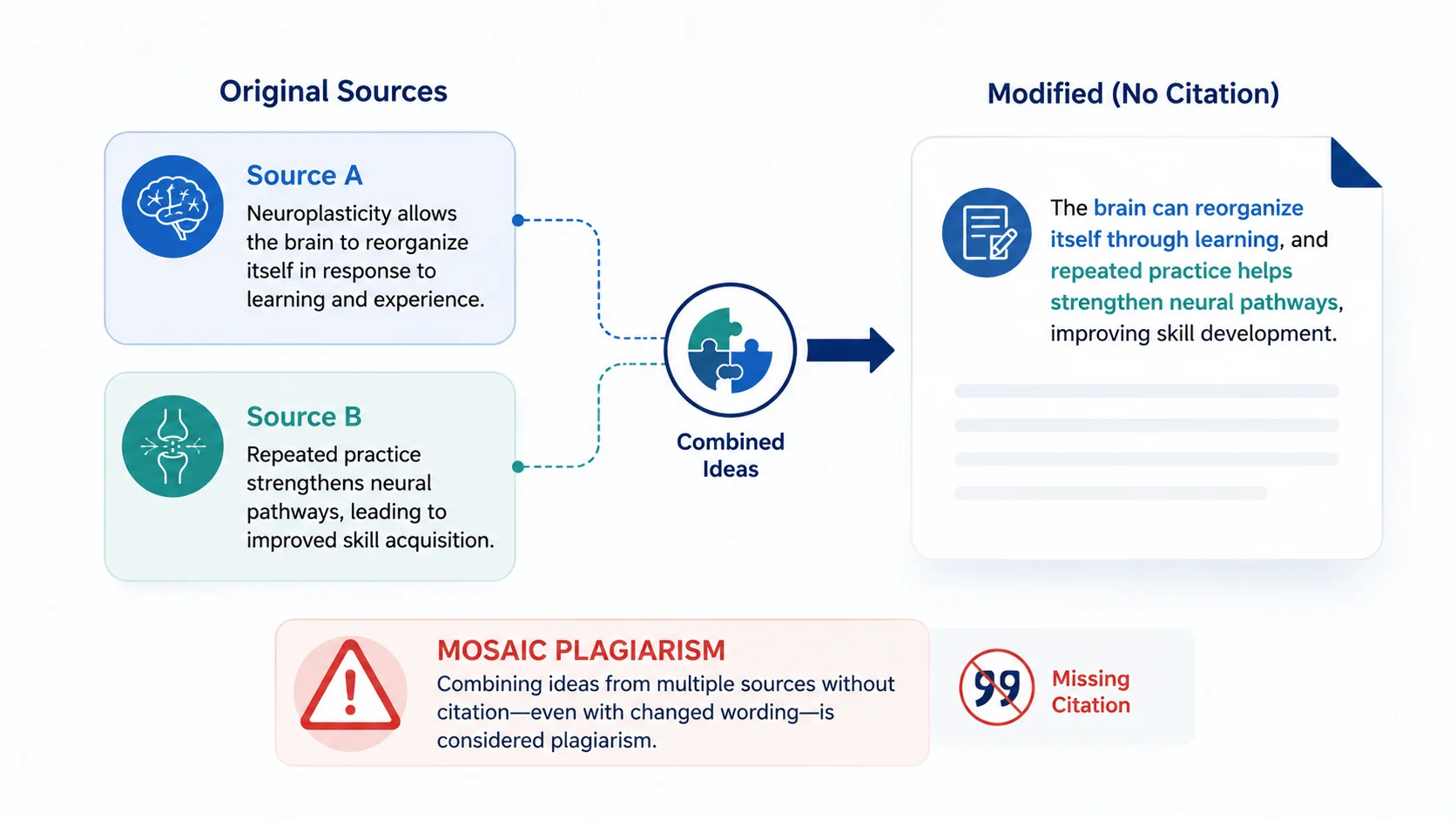
Modified:
The brain can reorganize itself through learning, and repeated practice helps strengthen neural pathways, improving skill development.
This sentence combines ideas from multiple sources into a single statement. Even though the wording is adjusted, the concepts are directly borrowed—and without proper citation, this becomes mosaic plagiarism.
What These Examples Have in Common
Across all these examples, the issue isn’t just about wording—it’s about ownership of ideas and expression:
The core ideas or structure originate from existing sources
The rewriting is too close to the original phrasing or logic
And there’s insufficient or missing citation
That’s exactly what turns “almost paraphrasing” into plagiarism.
Now that you can clearly recognize what mosaic plagiarism looks like, the next question is: why is it treated as such a serious issue in academic settings?
Why Is Mosaic Plagiarism a Serious Academic Issue?
Mosaic plagiarism is serious because academic writing depends on clear intellectual ownership. In research, it is not enough to make borrowed material “sound different.” Readers, reviewers, and editors need to know which ideas are original, which are adapted from previous scholarship, and which sources shaped the argument.
This is why universities, journals, and plagiarism detection tools may flag mosaic plagiarism even when the wording is not copied exactly. Similar phrasing, repeated sentence structures, and uncited conceptual borrowing can all suggest that a text is too closely dependent on existing work.
From an academic integrity perspective, the problem is not simply expression—it is attribution. A researcher may restate another scholar’s point in polished language, but if the source is unclear, the writing can misrepresent the origin of the idea. In publishing contexts, this can damage credibility and raise concerns during peer review or editorial screening.
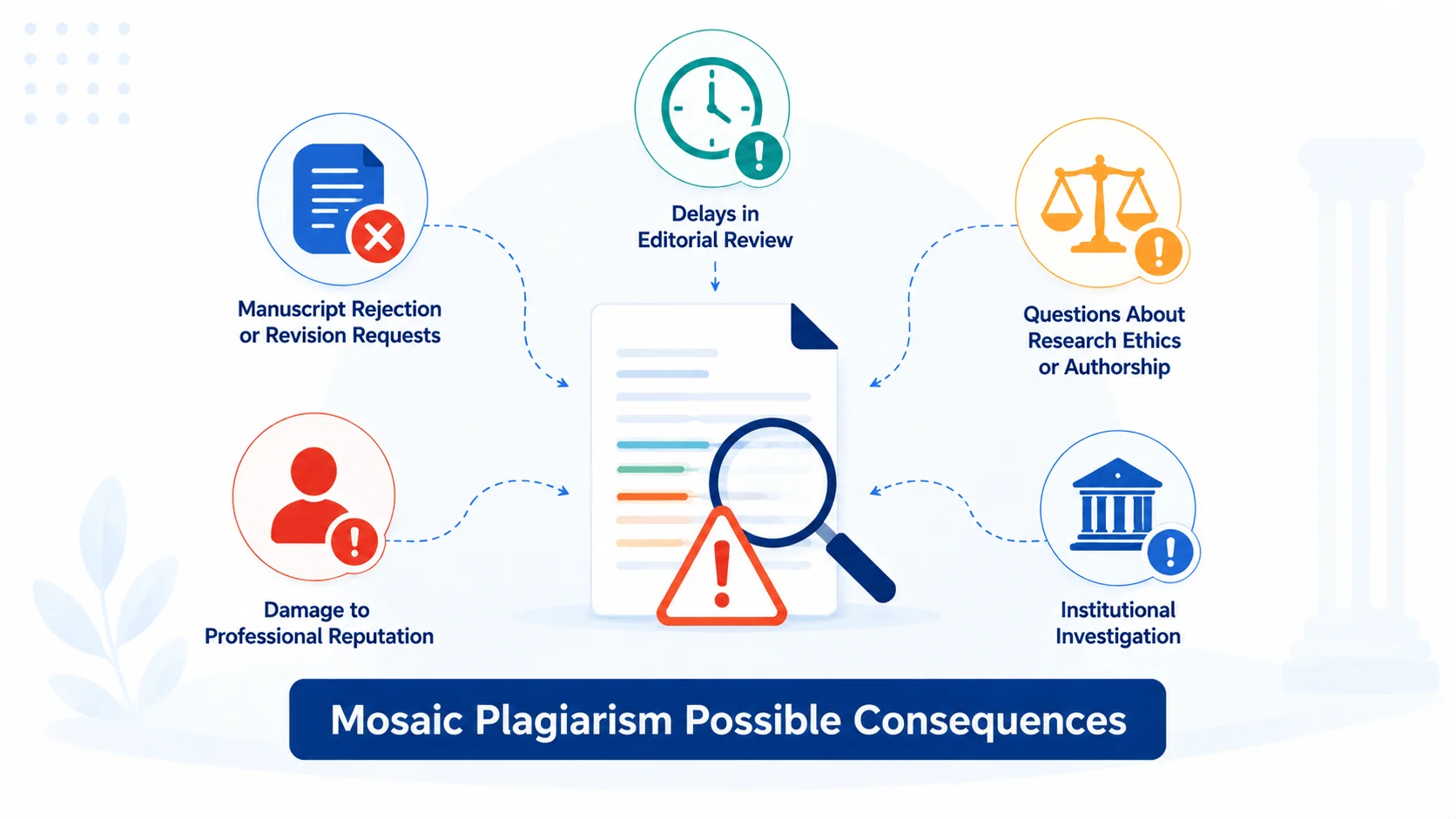
Possible consequences may include:
Manuscript rejection or revision requests
Delays during editorial review
Questions about research ethics or authorship
Damage to professional reputation
Institutional investigation in more serious cases
The difficult part is that mosaic plagiarism is not always intentional. Many writers fall into it while summarizing literature, building theoretical frameworks, or revising source-based notes. That’s why it helps to understand how it happens before learning how to avoid it.
Why You May Accidentally Commit Mosaic Plagiarism
Mosaic plagiarism often doesn’t come from intentional copying—it emerges from how academic writing is actually done. When you’re working closely with sources, especially during literature review or drafting, the boundary between your wording and the original text can blur more easily than expected.
One common reason is misunderstanding what paraphrasing really involves. Simply replacing a few words or adjusting phrasing can feel like sufficient rewriting, but without restructuring the idea or fully internalizing it, the result may still closely mirror the source.
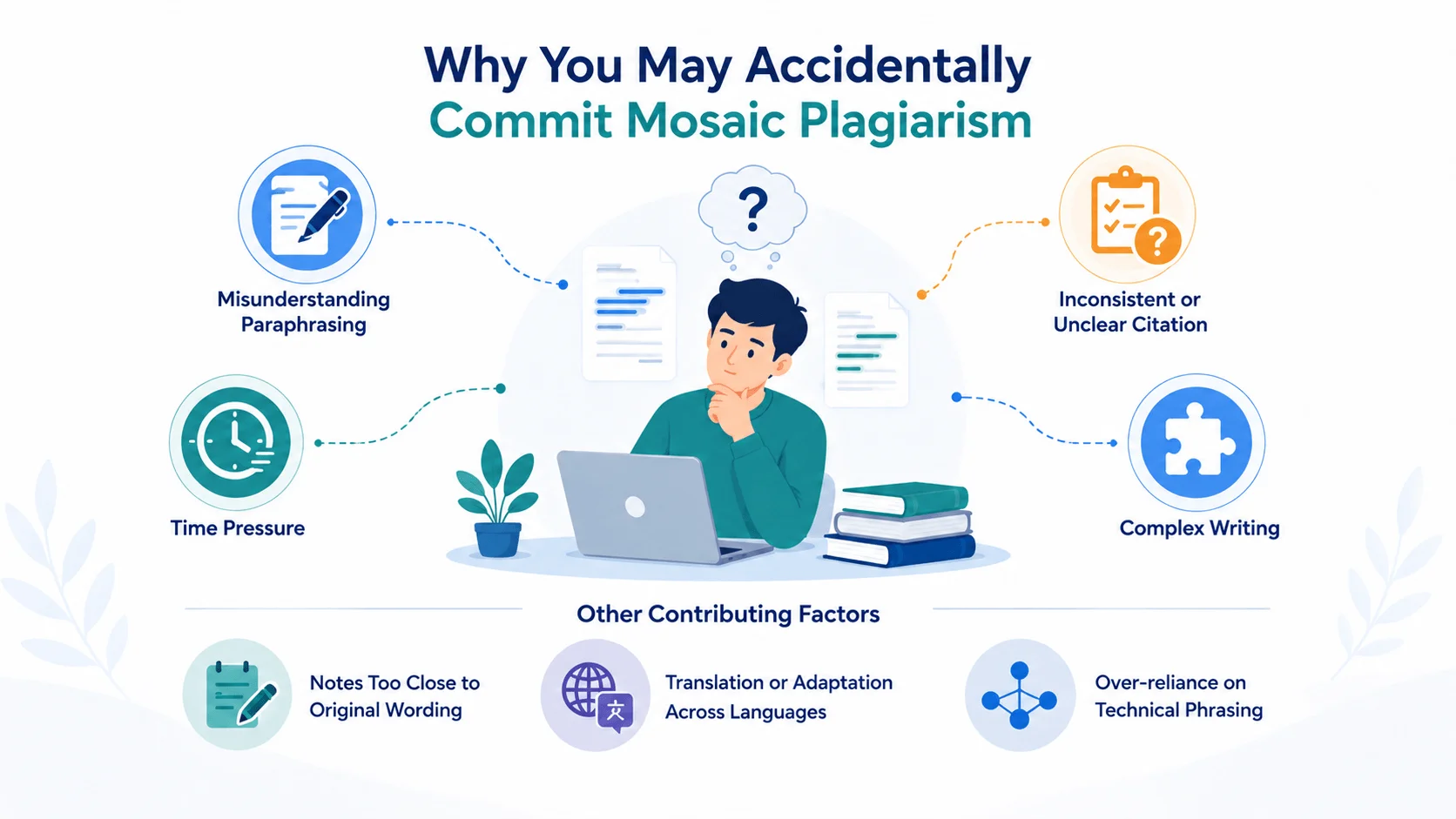
Another factor is inconsistent or unclear citation practices. In complex writing—where multiple studies, theories, or arguments are being synthesized—it’s easy to lose track of which idea came from where. When attribution becomes vague, even well-intended writing can raise concerns about originality.
Time pressure also plays a role. During tight deadlines, writers may rely heavily on source material while drafting, revising sentences directly instead of stepping back to reframe the idea. This “write-as-you-edit” approach often leads to text that stays too close to the original structure.
Other contributing factors include:
Working from notes that are too close to the original wording
Translating or adapting sources across languages without enough transformation
Over-reliance on highly technical phrasing that feels difficult to restate
The key issue here is not the use of sources—academic writing depends on it. The real challenge is how those sources are used, transformed, and credited.
How to Avoid Mosaic Plagiarism (Practical Tips)
1. Don’t Paraphrase Sentence-by-Sentence
One of the most common traps is rewriting directly from the source, line by line. This almost always leads to wording and structure that stay too close to the original.
A more effective approach is: read → understand → step away → rewrite. Try closing the source (or switching tabs) and then explain the idea in your own words. This forces you to process the meaning first, rather than relying on the original phrasing.
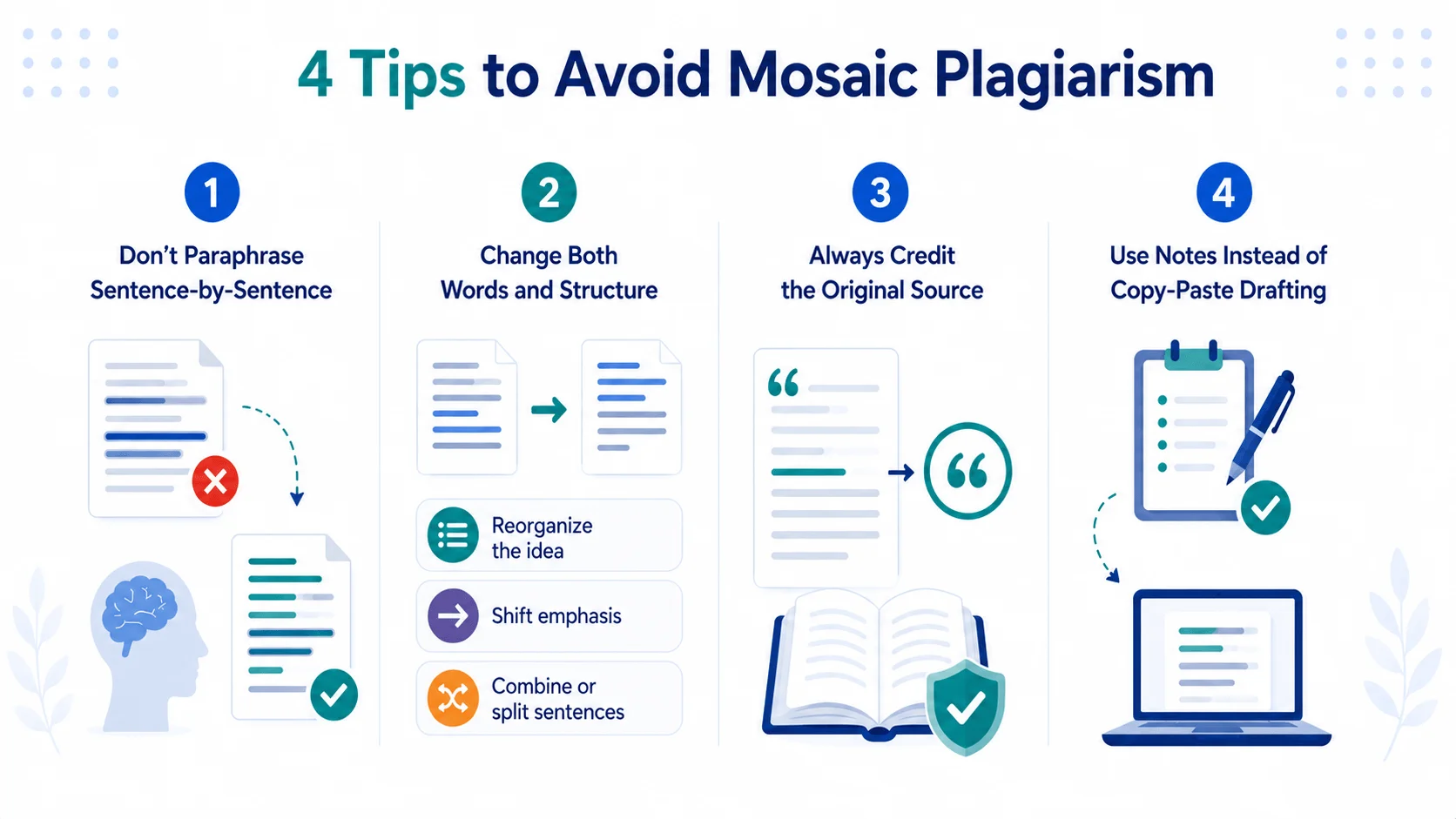
2. Change Both Words and Structure
Good paraphrasing goes beyond vocabulary. Even if every word is different, keeping the same sentence structure or logic can still result in mosaic plagiarism.
Instead, aim to:
Reorganize the idea (e.g., change the order of information)
Shift emphasis (start with a different concept)
Combine or split sentences where needed
This kind of restructuring shows that the idea has been fully reinterpreted, not just rewritten.
3. Always Credit the Original Source
Even when a passage is completely paraphrased, the underlying idea still belongs to the original author. That means citation is always required, not optional.
A simple rule: if the idea, data, or argument didn’t originate from you, it needs attribution. Clear citation not only avoids plagiarism concerns but also strengthens the credibility of your work.
4. Use Notes Instead of Copy-Paste Drafting
Many cases of mosaic plagiarism start early in the writing process—especially during note-taking. Copying sentences into drafts (even “temporarily”) makes it much harder to fully detach from the original wording later.
A better approach is to:
Take concept-based notes, not sentence-level notes
Summarize ideas in your own words from the beginning
Clearly label sources while note-taking
This reduces the risk of unintentionally stitching together source language during drafting.
In practice, many writers also use plagiarism-checking tools as a final step—not to “fix” writing, but to identify areas that may still be too close to source material before submission or publication.
With these strategies in place, the next step is to clearly distinguish between mosaic plagiarism and proper paraphrasing—because that difference is where most confusion still happens.
Final Thoughts
Mosaic plagiarism isn’t about using sources—it’s about using them without enough transformation or credit. The solution is simple in principle: understand the idea, rewrite it fully, and cite it clearly. When done right, source-based writing strengthens your work instead of putting it at risk.
FAQ

1. Is mosaic plagiarism still plagiarism if I change the words?
Yes. Even if the wording is different, the structure and underlying ideas may still come from the original source. Without sufficient rewriting and clear citation, it remains plagiarism.
2. Can mosaic plagiarism be detected by Turnitin iThenticate?
Yes. Tools like Turnitin iThenticate don’t just detect exact matches—they also identify similar phrasing, sentence structures, and patterns that closely resemble existing sources.
3. How much do I need to change to avoid mosaic plagiarism?
It’s not about how much you change, but how you change it. You need to fully understand the idea, restructure it in your own way, and provide proper citation.
4. Is mosaic plagiarism always intentional?
No. It often happens unintentionally during drafting or paraphrasing. However, it is still treated as plagiarism regardless of intent.
5. What is the safest way to paraphrase correctly?
Focus on three steps: understand the source, rewrite it completely in your own structure, and cite it clearly.