

Is Paraphrasing Plagiarism? What Counts & How to Stay Safe

Paraphrasing seems like a safe way to avoid plagiarism—but is it really?
Many people assume that changing a few words is enough, only to find their work still flagged by similarity checkers. The line between acceptable paraphrasing and plagiarism is often more subtle than expected.
This article breaks down what actually counts, why rewritten content can still trigger issues, and how to make sure your writing stays original and properly credited.
What Does Paraphrasing Actually Mean?
Paraphrasing means expressing someone else’s ideas in your own words while keeping the original meaning intact. It’s a core academic skill—not just a writing trick—and it shows that you actually understand the material, rather than simply copying it.
That said, many students today rely on tools like QuillBot or similar “rewriting” apps to paraphrase text quickly. While these tools can help rephrase sentences, they don’t guarantee that your writing is truly original or academically sound. In other words, using a tool is not the same as knowing how to paraphrase correctly.
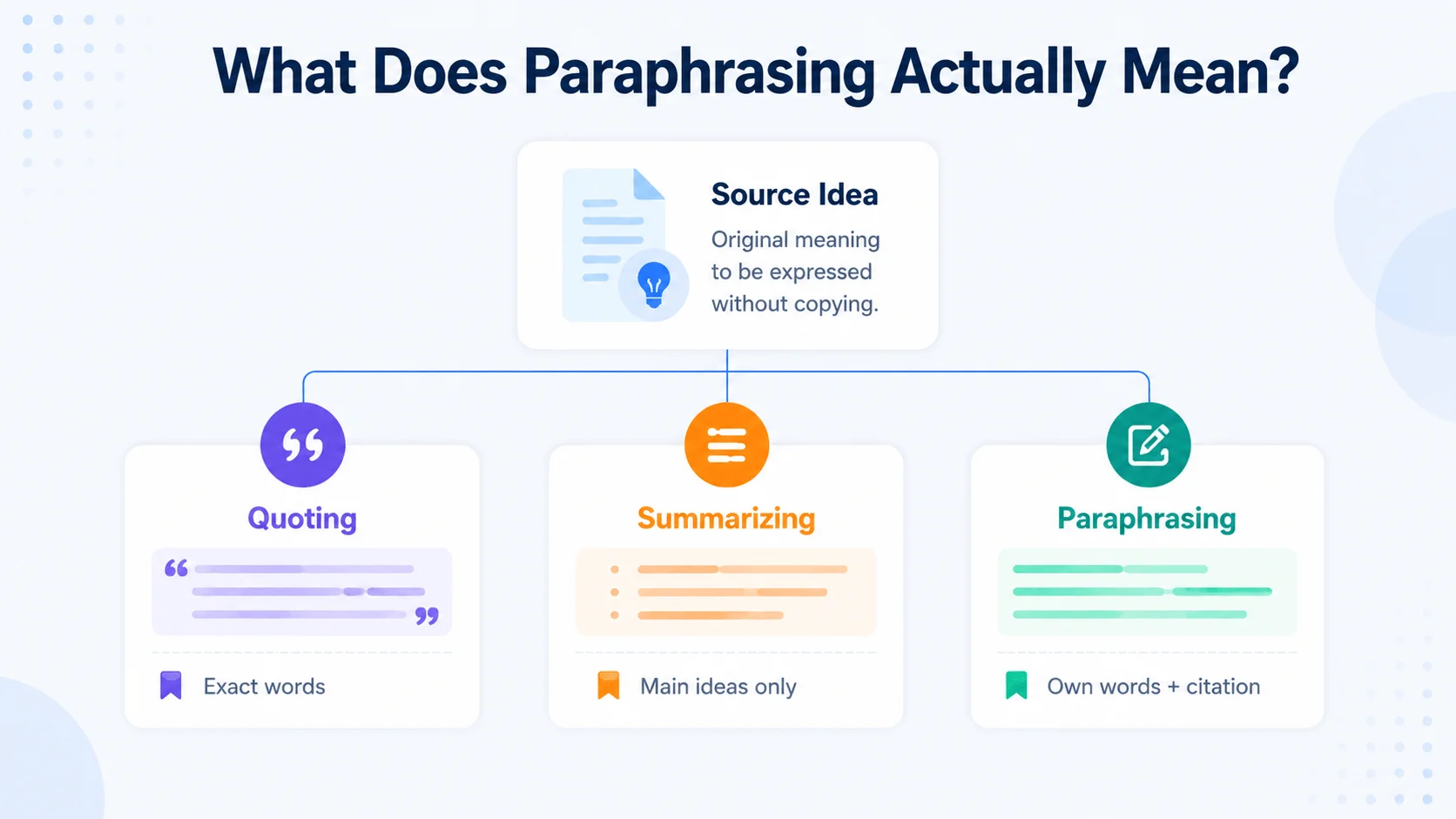
To understand this better, it helps to distinguish paraphrasing from two related concepts:
Quoting: Using the exact words from a source, placed in quotation marks, with proper citation
Summarizing: Condensing the main ideas of a larger passage into a shorter version
Paraphrasing: Rewriting a specific idea or passage in your own words, usually at a similar length, with citation
Each has its place in academic writing, but paraphrasing is often misunderstood because it seems simple on the surface.
Here’s the key point:
Paraphrasing itself is not the problem—the issue is whether it’s done correctly.
And this is where many students run into trouble. A lot of people assume that as long as they “change the wording,” they’re safe from plagiarism. But in reality, that’s not always the case.
Is Paraphrasing Plagiarism?
So, is paraphrasing plagiarism?
It depends.
Paraphrasing can be completely acceptable in academic writing—but only when it’s done properly. The difference comes down to how you rewrite the content and whether you give credit to the original source.
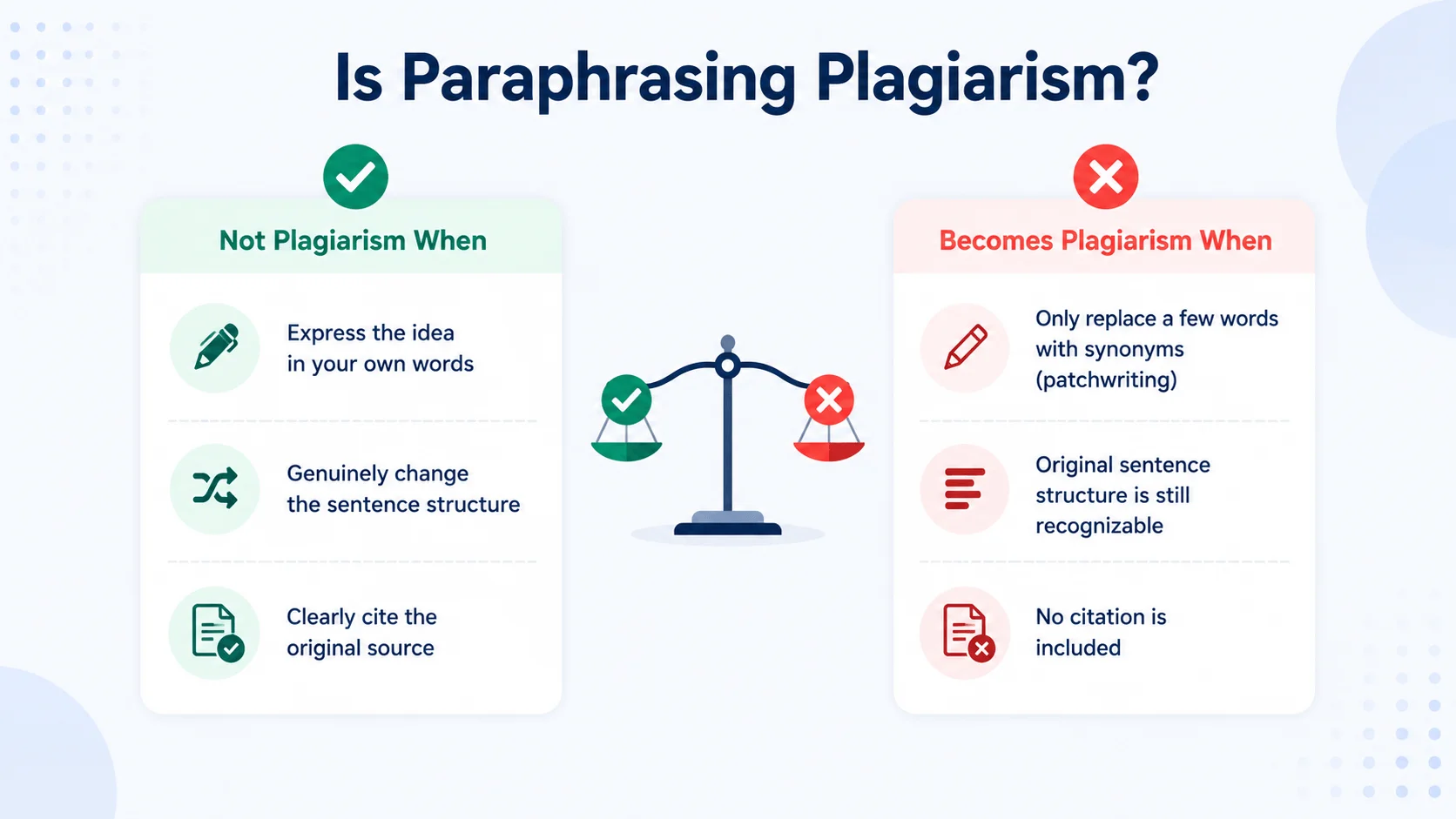
✅ Not plagiarism when:
You express the idea fully in your own words
The sentence structure is genuinely changed (not just swapping a few words)
You clearly cite the original source
❌ Becomes plagiarism when:
You only replace a few words with synonyms (patchwriting)
The original sentence structure is still recognizable
You don’t include a citation
Here’s the rule many students overlook: Paraphrasing without citation is still plagiarism.
Paraphrasing vs Plagiarism: Key Differences
Paraphrasing | Plagiarism |
|---|---|
Proper citation | No citation |
Original wording | Copy structure |
Shows understanding | Just rewording |
In short, paraphrasing reflects understanding, while plagiarism often reveals imitation.
Why Paraphrasing Still Gets Flagged in Plagiarism Checkers
At this point, a common question comes up:
If I already paraphrased, why is my work still getting flagged?
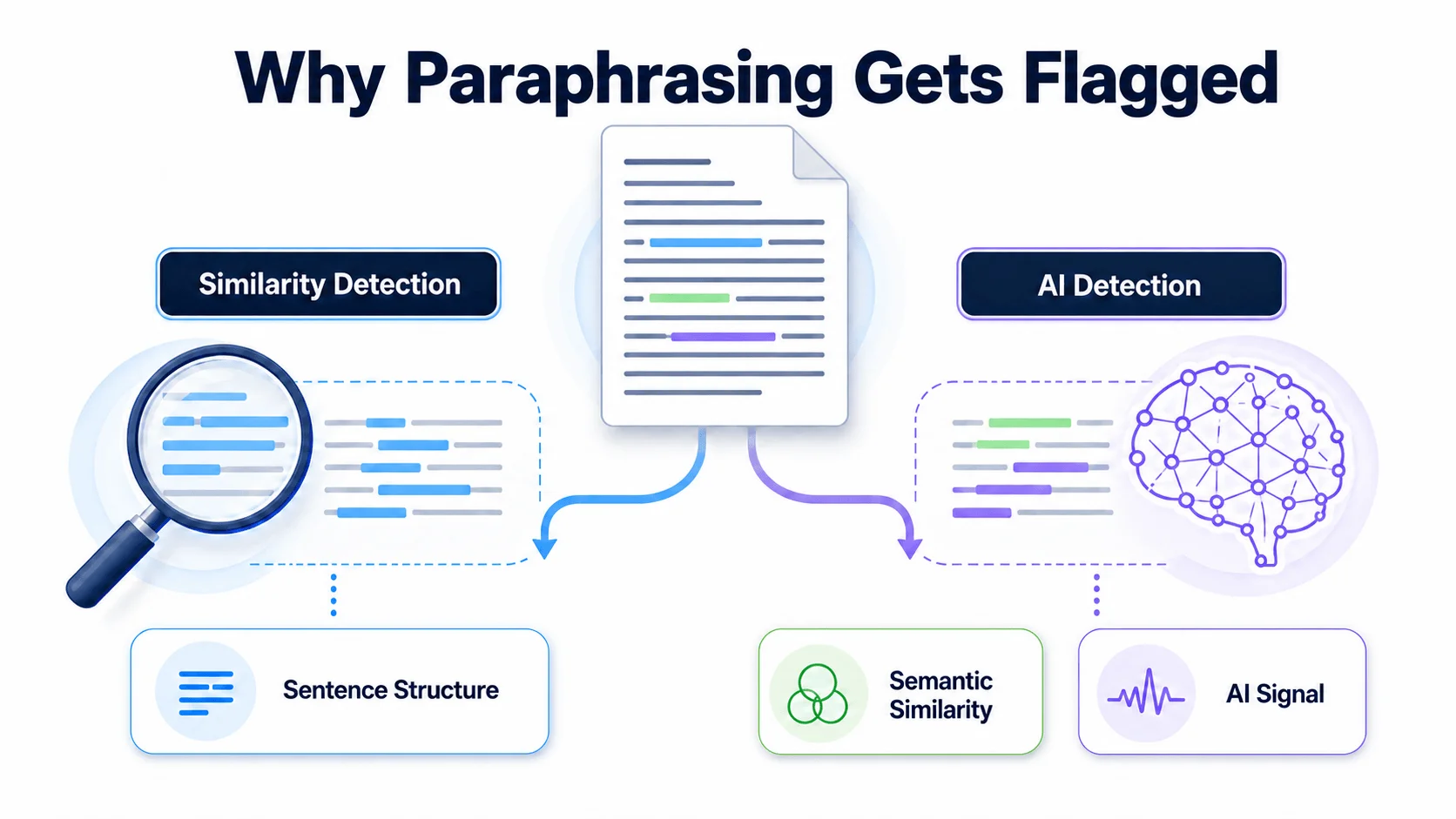
The answer lies in how modern detection systems actually work. Not all checkers are looking for the same thing—and many students don’t realize there are two different types of analysis happening.
1. Similarity Detection (Turnitin Similarity Report)
These systems focus on text similarity, but not just in the obvious way.
They don’t only detect exact word-for-word matches. Instead, they also look at:
Sentence structure
Phrase patterns
Semantic similarity (how closely your wording matches the original meaning and flow)
This means even if you change individual words, your writing can still be flagged if:
The structure is too similar
The idea is expressed in nearly the same way
The rewrite feels like a “mirror” of the original text
2. AI Detection (GPTZero, Turnitin AI writing indicator and similar tools)
Separate from plagiarism, many platforms now include AI detection reports.
These tools don’t compare your text to sources. Instead, they analyze:
Writing patterns
Predictability and fluency
Whether the text “looks like” it was generated by AI
So even if your paraphrasing is original, it might still trigger an AI flag if it follows patterns typical of AI-generated writing.
👉 In other words: similarity ≠ AI detection. They measure completely different things.
So why does paraphrasing still get flagged?
Even after rewriting, your text may still be marked because:
Your version is too close to the original structure
The meaning and phrasing are still highly similar
You haven’t truly reconstructed the idea in a new way
This is why simply “changing words” isn’t enough. Effective paraphrasing requires deeper transformation—not just surface-level edits.
How to Paraphrase Without Plagiarizing
Effective paraphrasing isn’t about changing a few words. It’s a step-by-step process that requires comprehension and reconstruction.
Here’s how to do it properly:
Read → Understand → Rewrite
Don’t paraphrase while looking at the original sentence. Read it, make sure you understand it, then write it from memory.
Change the sentence structure
Adjust the way the sentence is built. This can include:
Switching between active and passive voice
Reordering ideas
Breaking one sentence into two (or combining them)
Avoid simple synonym replacement
Swapping words with similar ones often leads to patchwriting, which is still detectable.
Add your own understanding
Put the idea into context or reframe it in a way that reflects how you interpret it.
Always cite the source
Even a perfect paraphrase still requires proper attribution.
Example: What Good vs. Bad Paraphrasing Looks Like
Original sentence:
Students who rely too heavily on AI tools may struggle to develop critical thinking and writing skills over time.
❌ Incorrect paraphrase (patchwriting):
Students who depend too much on AI tools might have difficulty developing critical thinking and writing skills over time.
👉 What’s wrong:
Sentence structure is nearly identical
Only minor word substitutions were made
Easily flagged by similarity checkers
✅ Correct paraphrase: Overusing AI tools can limit a student’s ability to build strong writing and analytical skills, especially in the long run.
👉 Why this works:
Sentence structure is changed
Ideas are re-expressed, not mirrored
The meaning is preserved, but the wording is original
How to Check If Your Paraphrasing Is Safe
At this point, a common thought is: “I’ve changed enough—it should be fine.”
But in reality, what feels rewritten doesn’t always look that way to detection systems.
Most people don’t realize their paraphrasing is still too close until it’s too late.
That’s why checking your work before submission matters.
One practical way to do this is by using tools like Thentify.com. It works similarly to iThenticate, giving you both a similarity score and an AI detection report, so you can see how your writing might actually be evaluated.
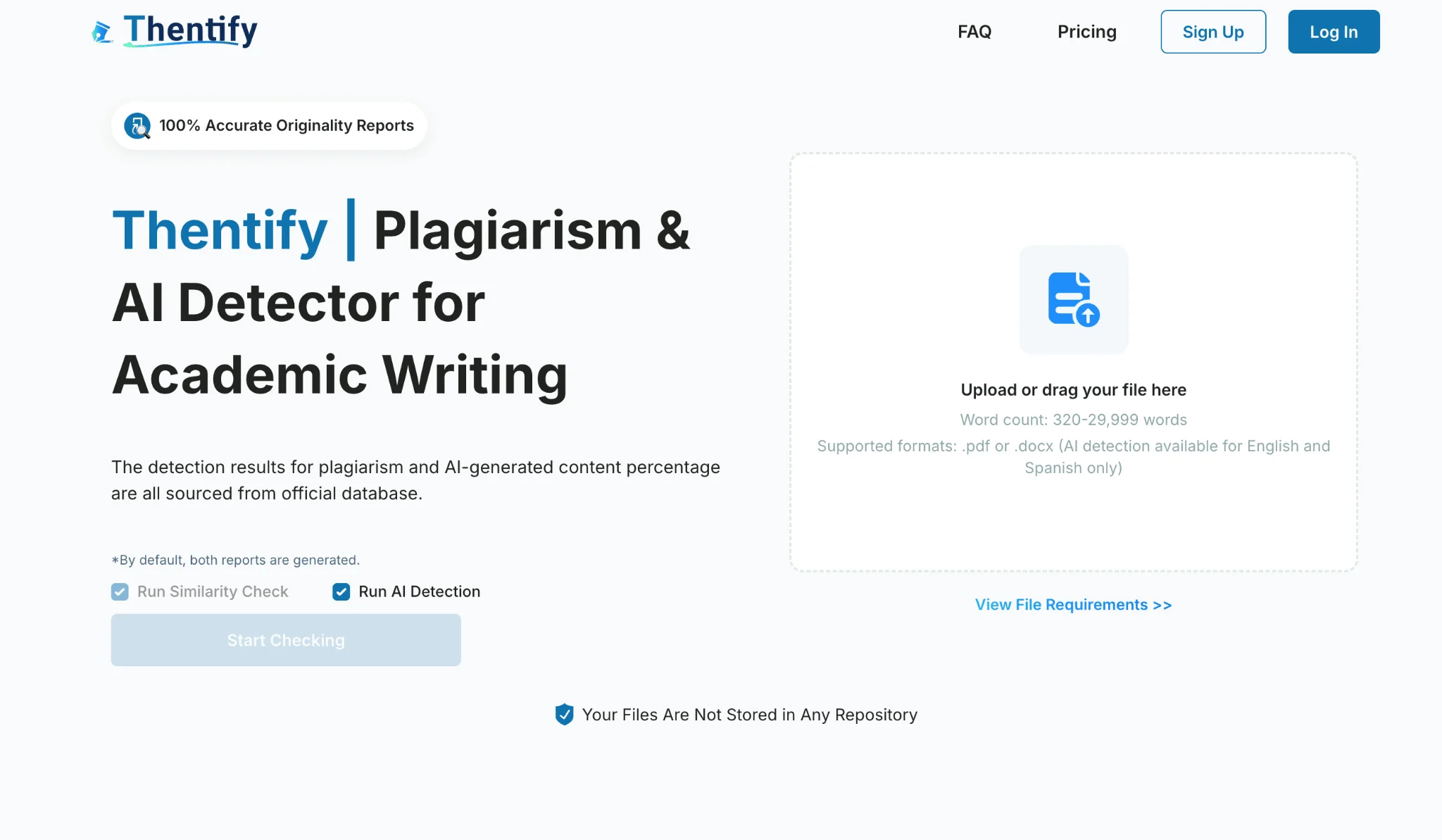
Unlike many academic systems, your content isn’t stored in a database. This allows you to revise and recheck freely—without worrying about your text being saved or affecting future submissions.
Final Thoughts: Paraphrasing Is a Skill—Not a Shortcut
So, is paraphrasing plagiarism? Not always—but rewriting alone doesn’t make content safe. The key is understanding the source, expressing it in a new way, and giving proper credit. When done right—understand → rewrite → cite—paraphrasing becomes a reliable writing skill, not a risk.
FAQ
Is paraphrasing plagiarism if I change the words?
Not necessarily—but changing words alone isn’t enough. If the sentence structure and meaning remain too close to the original, it can still be considered plagiarism. True paraphrasing requires fully rewriting the idea in your own way and citing the source.
Do I still need to cite when paraphrasing?
Yes. Even if you rewrite everything in your own words, the idea still belongs to the original author. Paraphrasing without citation is still plagiarism.
Can tools like QuillBot cause plagiarism?
They can contribute to it if used incorrectly. Tools like QuillBot often produce surface-level rewrites that keep the original structure, which can still be flagged by similarity checkers. They’re helpful for brainstorming, but they don’t replace proper paraphrasing.
Why is my paraphrasing still showing high similarity?
This usually happens when:
The structure is too similar to the original
The wording is slightly changed but not fully reworked
The idea is expressed in almost the same way
Even without copying, the text can still be flagged if it’s too close.
How can I check before submitting to Turnitin iThenticate?
You can use tools like Thentify.com to preview how your work might be evaluated. It provides both a similarity score and an AI detection report, helping you identify issues early and revise before submission—without your content being stored.