

Is iThenticate Reliable? Accuracy, Limits, and AI Detection

iThenticate has become one of the most widely used screening tools in academic publishing. Many journals now rely on it for similarity checks, manuscript screening, and increasingly, AI writing detection.
But widespread use does not automatically answer a more practical question: how reliable is iThenticate in real editorial workflows?
This guide explains where iThenticate performs well, where its limitations appear, and how editors actually interpret similarity and AI detection reports before peer review.
Why iThenticate Is the Primary Choice
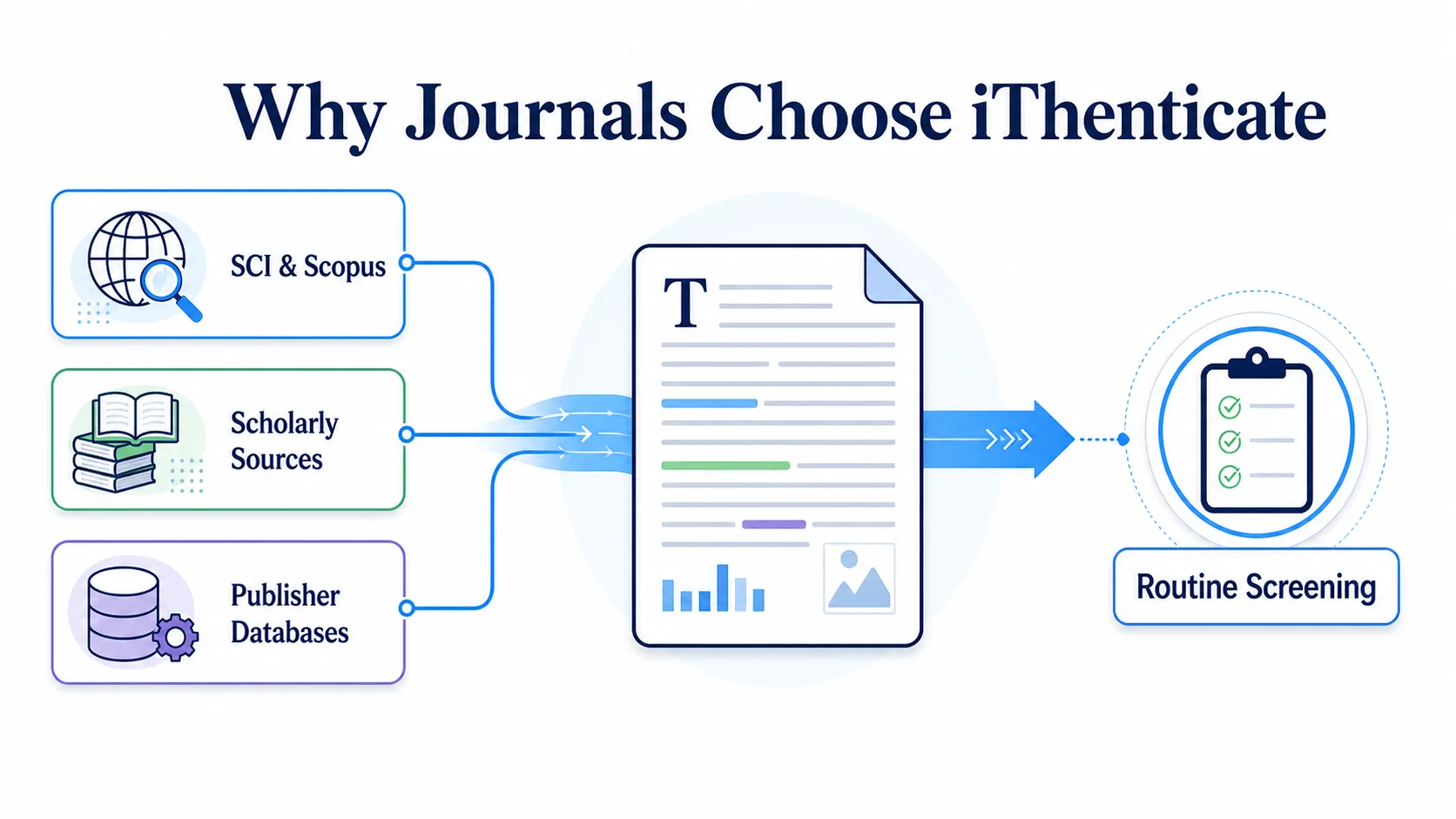
Before discussing whether iThenticate is truly reliable, it is helpful to first understand its position within academic publishing. Many publishers use iThenticate as a routine integrity screening step before peer review, particularly across SCI and Scopus-indexed journals. One major reason is its extensive scholarly database coverage.
Unlike basic plagiarism detection tools that mainly scan public websites, iThenticate compares manuscripts against journal articles, conference papers, dissertations, and scholarly databases through Crossref and publisher-linked sources. This makes it significantly more effective for identifying overlap within academic literature rather than only public internet content.
Its value also comes from supporting a consistent editorial screening workflow. Similarity reports help editors quickly identify potential overlap patterns across large volumes of submissions, while newer versions of iThenticate 2.0 include AI-writing detection alongside traditional similarity analysis.
With journals relying so heavily on the system, an important question naturally follows: how reliable is iThenticate when evaluating problematic manuscripts in real publishing scenarios?
To answer that question, it helps to separate the areas where iThenticate performs consistently from the situations where similarity detection becomes far less straightforward.
Where iThenticate Is Actually Reliable
Detecting Direct Text Overlap
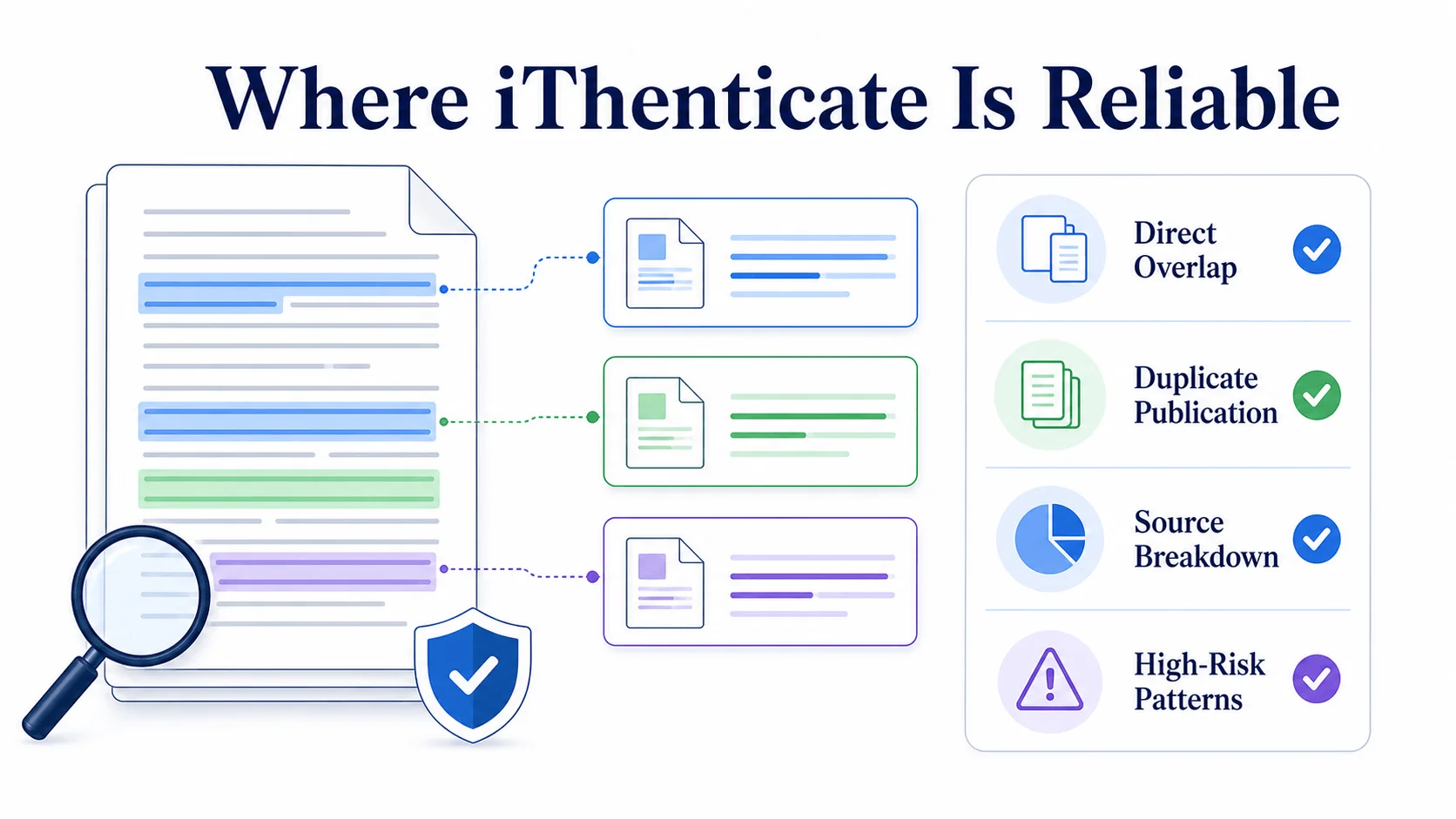
iThenticate is strongest at detecting obvious textual overlap. It performs reliably with copy-paste plagiarism, duplicate publication, and large matched sections from published literature. Because its database includes millions of academic papers and publisher sources, editors can quickly identify reused material that normal web-based plagiarism tools often miss.
Identifying Citation and Attribution Problems
The software is also useful for spotting weak attribution practices. Similarity reports can reveal overly close paraphrasing, repeated dependence on one source, or missing citations around reused ideas. On Reddit and Quora, several researchers mention that the detailed source breakdown is often more helpful than the similarity percentage itself because it shows exactly where overlap appears.
Supporting Pre-Submission Risk Screening
Many labs and editorial offices use iThenticate before submission rather than after rejection. It helps researchers review risky sections early, especially literature reviews and methodology descriptions where accidental overlap is common. The reporting system also allows exclusions for quotes, references, and small matches, making screening more practical for real submission workflows.
Why Editors Can Quickly Spot High-Risk Manuscripts
Experienced editors rarely focus on the number alone. They look for patterns: repeated overlap from the same paper, long matched passages, or structural similarity across sections. In academic forums, some editors note that high-risk manuscripts are often obvious within minutes once these patterns appear in the report.
However, similarity detection becomes far less straightforward once authors begin heavily paraphrasing, restructuring source material, or using AI-assisted drafting tools. In these situations, textual overlap may decrease while deeper originality and attribution concerns still remain.
Where iThenticate Becomes Less Reliable
Similarity Scores Can Be Misleading
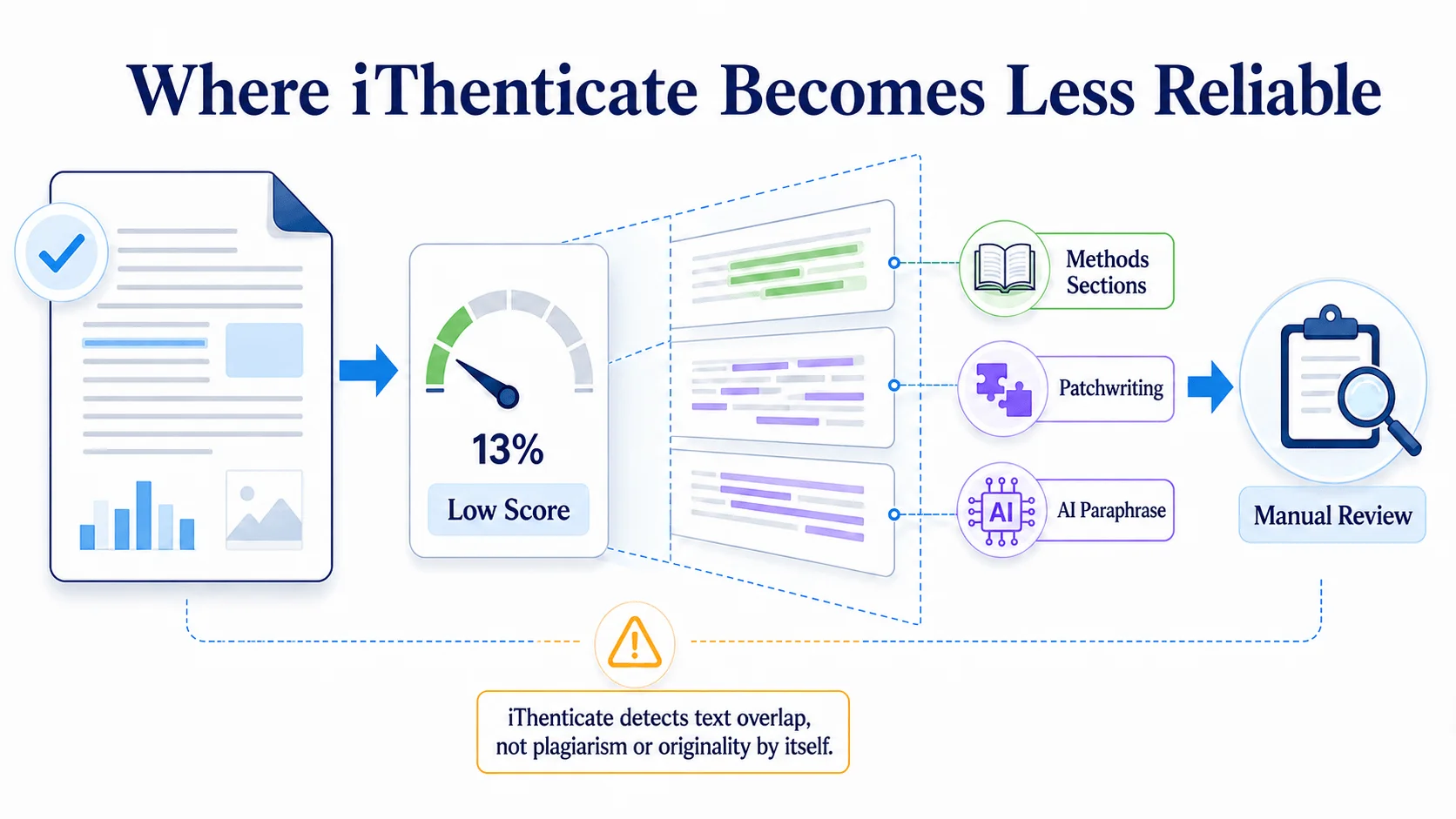
iThenticate detects text overlap, not plagiarism itself. Some papers naturally generate higher similarity scores even when nothing unethical happened, especially:
methods sections
review papers
thesis-derived manuscripts
standard academic phrasing
This is why experienced editors usually read the report itself instead of reacting only to the percentage.
Paraphrased Plagiarism Can Still Escape Detection
The system becomes less reliable once authors heavily rewrite text instead of directly copying it. Patchwriting, semantic rewriting, and AI-assisted paraphrasing can reduce visible overlap while keeping the same underlying ideas.
On Reddit and Quora, some researchers note that papers can pass similarity screening but still feel academically suspicious during peer review.
Low Similarity Scores Can Create False Confidence
A low similarity score does not automatically mean a manuscript is strong or original. Editors may still encounter problems such as:
weak novelty
fabricated citations
AI-generated academic wording
shallow literature synthesis
This became more noticeable after AI writing tools entered academic publishing workflows.
Chasing a Lower Score Can Make a Paper Worse
Many authors over-edit simply to reduce the percentage. That often creates awkward wording, unnecessary paraphrasing, and less readable academic writing.
These limitations became much more noticeable once AI-generated writing started appearing in academic publishing workflows. That shift has also changed the conversation around iThenticate itself, especially as journals and institutions increasingly rely on AI-writing detection alongside traditional similarity screening.
Is iThenticate Reliable for Detecting AI Writing?
iThenticate 2.0 now includes AI writing detection alongside traditional similarity reports. Unlike plagiarism matching, AI detection focuses on identifying language patterns associated with generative AI writing.
The feature is designed for journal screening and research integrity workflows, but iThenticate also states that AI indicators should not be treated as definitive proof of misconduct.
How Reliable Is iThenticate’s AI Detection?
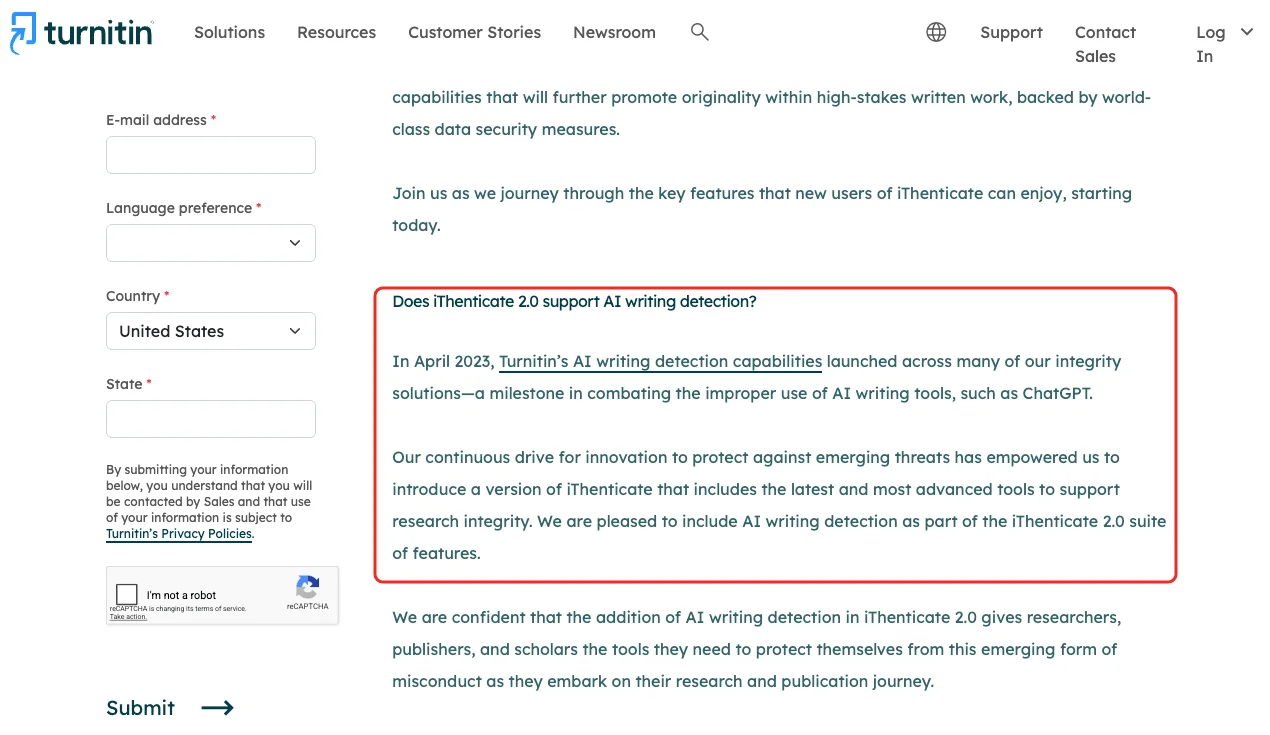
According to descriptions provided on the official iThenticate website, it is clear that the AI writing detection capability used in iThenticate 2.0 is closely connected to Turnitin’s AI detection technology. The website explicitly states that Turnitin’s AI writing detection capabilities were launched across many of its integrity solutions in April 2023, and that iThenticate 2.0 now incorporates AI writing detection as part of its feature suite. This suggests that iThenticate’s AI detection system is fundamentally based on the same underlying technology and framework developed by Turnitin.
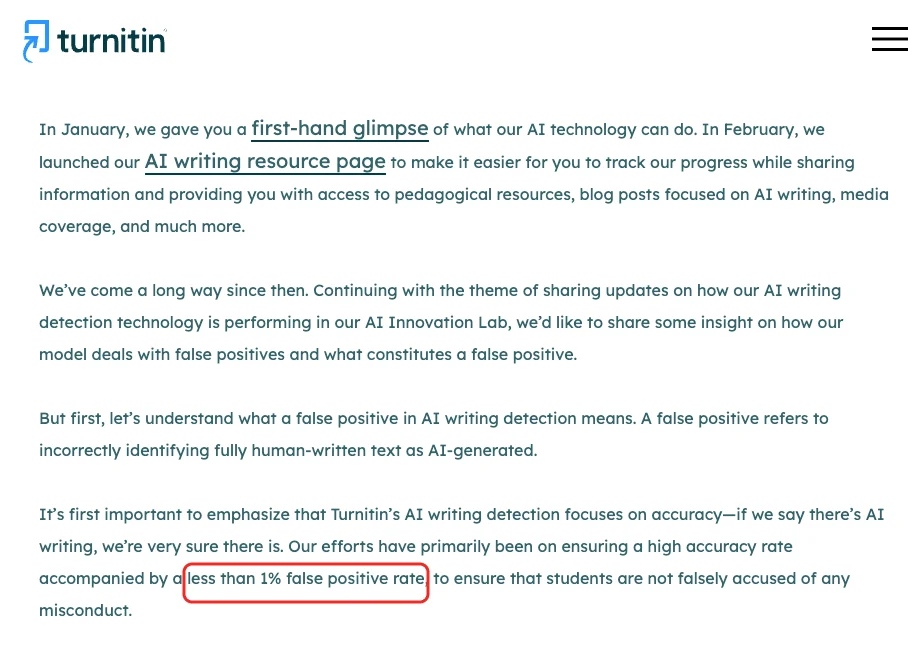
Turnitin’s official website also provides additional context regarding the claimed accuracy of its AI detection model. The company emphasizes that its system is designed with a strong focus on accuracy and states that when AI-generated writing is identified, the model is intended to have a high degree of confidence. At the same time, Turnitin highlights efforts to minimize false accusations, claiming that its false positive rate is below 1%.
However, the reliability of AI detection becomes far more complicated once AI-generated text has been heavily edited, paraphrased, or humanized. iThenticate itself acknowledges that AI-generated and AI-paraphrased content may not always be detected accurately. As a result, even officially reported low false positive rates do not completely eliminate concerns about potential misclassification in real-world academic contexts.
Online Discussions Show Differing Views on AI Detection Reliability
Discussions specifically about iThenticate’s AI detection accuracy remain relatively limited. However, as noted earlier, iThenticate’s AI detection system is based on the same underlying technology as Turnitin’s AI detector. As a result, many online discussions about Turnitin are also relevant when evaluating the broader reliability of AI detection in academic publishing.
In Reddit discussions about Turnitin’s AI detection, users report mixed views on its accuracy and consistency. In the referenced discussion, some commenters argued that Turnitin can often detect heavily AI-generated assignments, especially when students submit minimally edited ChatGPT outputs. Others noted that instructors could sometimes recognize AI-style writing patterns even when the text appeared polished.
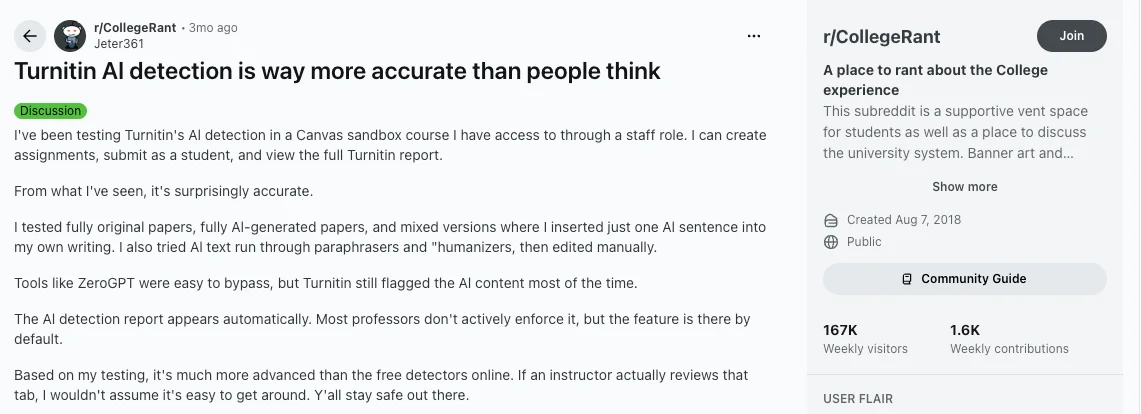
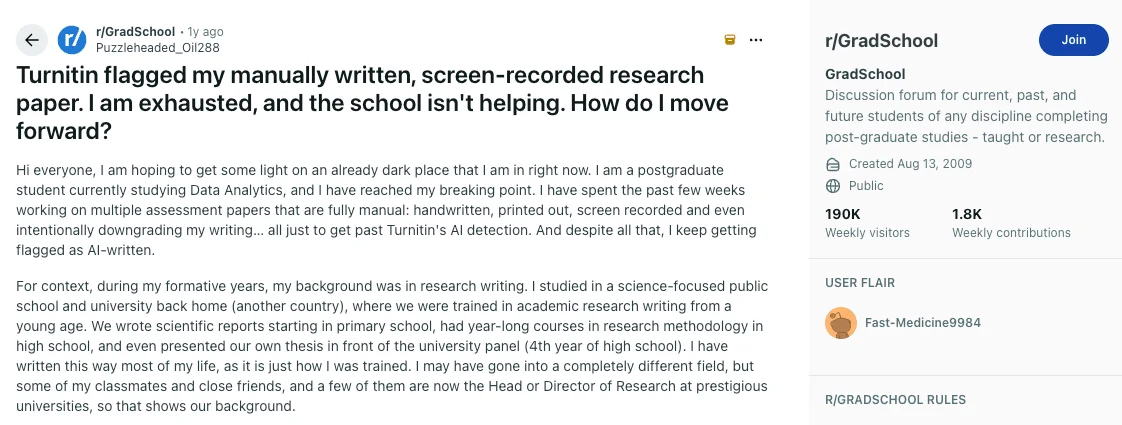
At the same time, several users raised concerns about false positives and inconsistent results. Commenters pointed out that formal academic writing, polished English, or partially edited AI-assisted content could still receive high AI scores. Overall, the discussion reflects continuing uncertainty about how reliable AI detection tools currently are for academic screening and manuscript evaluation.
How Reliable Is iThenticate Compared With Other Academic Detection Tools?
iThenticate vs Other Academic Detection Tools
Feature | iThenticate | Turnitin | Grammarly Plagiarism Checker |
|---|---|---|---|
Main Use Case | Journal & research screening | Student assignments | General writing |
Academic Database Coverage | Very strong | Strong | Limited |
AI Writing Detection | Yes | Yes | Limited |
Sentence-Level Similarity Review | Yes | Yes | Basic |
Best For | Researchers & publishers | Universities | Casual plagiarism checks |
Why iThenticate Remains the Standard for Journal Screening
iThenticate remains the preferred tool for many publishers because it was built specifically for research integrity workflows rather than classroom assignments or web content checking.
Its biggest advantage is academic database access. Compared with general plagiarism tools, iThenticate can compare manuscripts against a much larger collection of journal articles, conference papers, and scholarly repositories. That makes it more useful for editorial screening before peer review.
In academic forums, many researchers also describe iThenticate reports as more detailed and publication-oriented than consumer plagiarism checkers.
Where iThenticate Faces the Same Limitations as Other Detection Tools
Despite its stronger academic infrastructure, iThenticate still shares several limitations common across detection platforms:
AI-generated content may bypass detection after revision or paraphrasing
similarity scores still require human interpretation
false positives remain possible in formal academic writing
no detection tool can fully evaluate originality or research integrity automatically
Ultimately, editors still rely far more on contextual review and academic judgment than on a single detection score.
How Researchers Should Use iThenticate More Reliably
Stop Treating the Similarity Percentage as a Verdict
A higher score in references or methods sections may be normal, while smaller matches in the discussion or novelty claims can create bigger concerns. Context matters more than raw numbers.
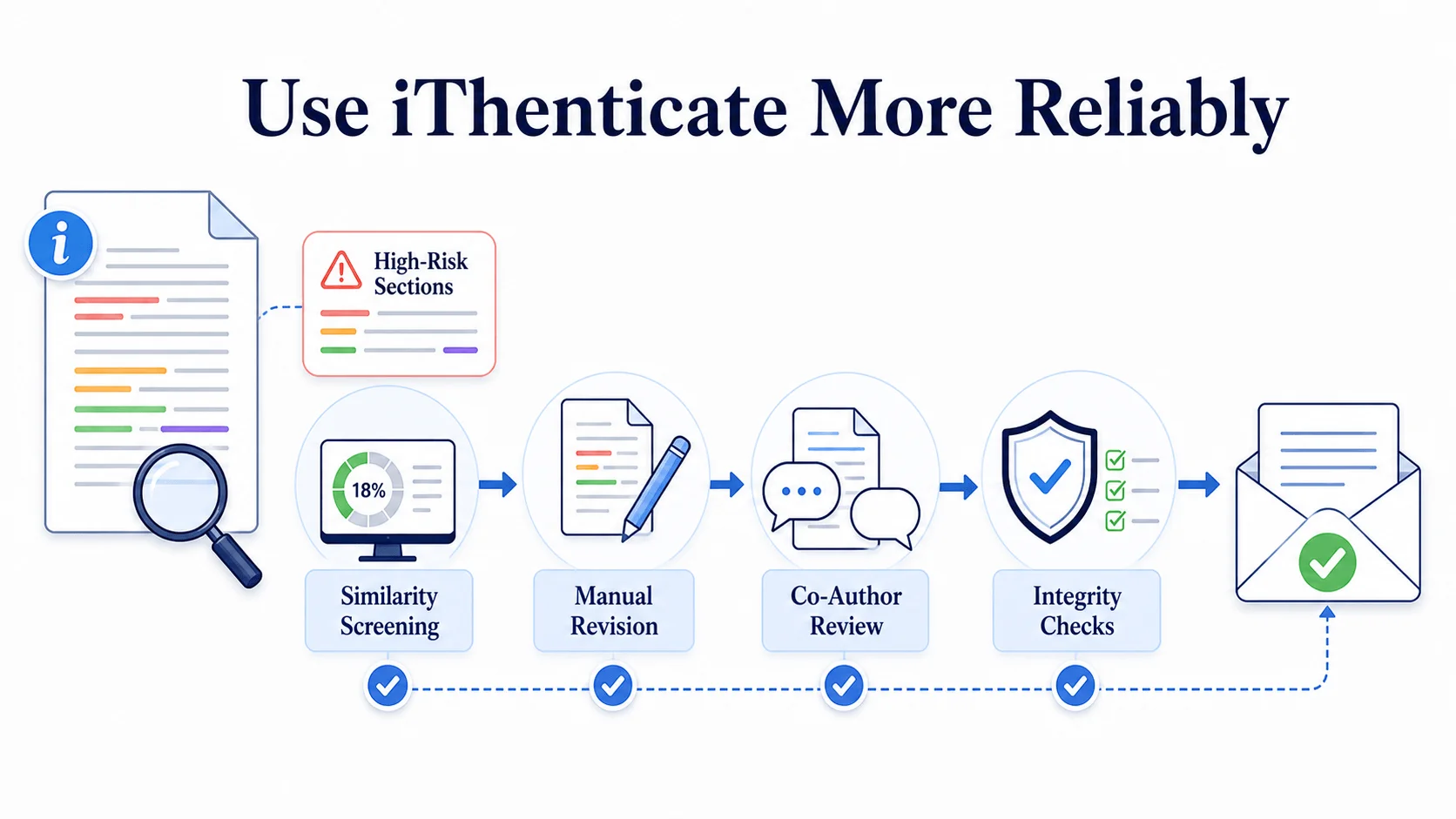
Review High-Risk Sections First
Before submission, researchers should pay closer attention to sections most likely to trigger editorial concern, especially:
abstract
discussion
conclusion
novel contributions
These areas are reviewed more carefully for originality and argument consistency.
Pay Extra Attention to AI-Assisted Sections
If AI tools were used during drafting or editing, extra review is important. Researchers should verify:
citations
factual accuracy
logical flow
tone consistency
Many AI-related problems come from weak verification rather than high similarity scores.
Build a Safer Pre-Submission Workflow
iThenticate works best as part of a broader submission workflow rather than a final “safe or unsafe” decision tool.
A more reliable process usually includes:
similarity screening
manual revision
co-author review
optional integrity-check tools
In practice, editors trust well-reviewed manuscripts more than perfectly optimized similarity percentages.
So, Is iThenticate Reliable?
After examining where iThenticate performs well, where its limitations appear, and how AI detection has complicated modern similarity screening, the answer becomes more nuanced than a simple yes or no.
Overall, iThenticate remains one of the most reliable systems currently used for academic similarity screening. Its extensive scholarly database, publisher integration, and standardized reporting workflows have made it a central part of journal submission and research integrity review across many publishing environments.
At the same time, similarity reports were never designed to function as automatic judgments of plagiarism, originality, or AI authorship. In practice, the reliability of any report still depends heavily on editorial interpretation, manuscript context, citation quality, and broader human review. Experienced editors rarely treat iThenticate as a final verdict. Instead, they use it as one tool within a much larger academic evaluation process.
FAQ
Is iThenticate reliable for journal submission?
Yes. iThenticate is widely used by publishers for academic similarity screening before peer review.
Can iThenticate detect AI-generated writing?
Yes, iThenticate 2.0 includes AI writing detection. However, AI scores still require human interpretation.
What similarity score is considered safe?
There is no universal safe score. Editors usually care more about overlap context than the final percentage.
Why do journals trust iThenticate?
Journals trust iThenticate because of its large academic database and standardized screening workflow. It is designed specifically for scholarly publishing.
Can a paper with low similarity still be rejected?
Yes. A low similarity score does not guarantee originality, novelty, or research quality.
Is iThenticate better than Turnitin for researchers?
Generally, yes for journal submissions. iThenticate is designed more for publishers and research integrity workflows.
Are AI detection tools more accurate than iThenticate?
Not always. Most AI detection tools still face false positives and inconsistent results after rewriting or paraphrasing.